
Table of Contents
Your SEO is clean. Rankings holding. Search Console showing nothing wrong.
But your brand is quietly disappearing from ChatGPT responses. Gemini stopped naming you. Perplexity citations that included your domain a few months ago no longer do.
No penalty. No algorithm update. Nothing you can point to.
That’s Citation Drift and it’s one of the most common LLM SEO problems I see across client audits right now.
What I actually found
A few weeks ago I was auditing how ChatGPT cites SEO resources. It referenced a Search Engine Land article “Advanced AI Prompt Engineering Strategies for SEO” as a source on prompt optimization.
Looked credible. I clicked through.
The URL existed. The page didn’t match. The content had been completely replaced — same URL, different topic. What was once a detailed AI SEO guide was now a Performance Max advertising update.
ChatGPT was still citing it as an authoritative source on AI prompt strategy. Because that’s what it learned it was.
The page changed. The AI’s understanding of it didn’t.
That’s Citation Drift.
What Citation Drift is
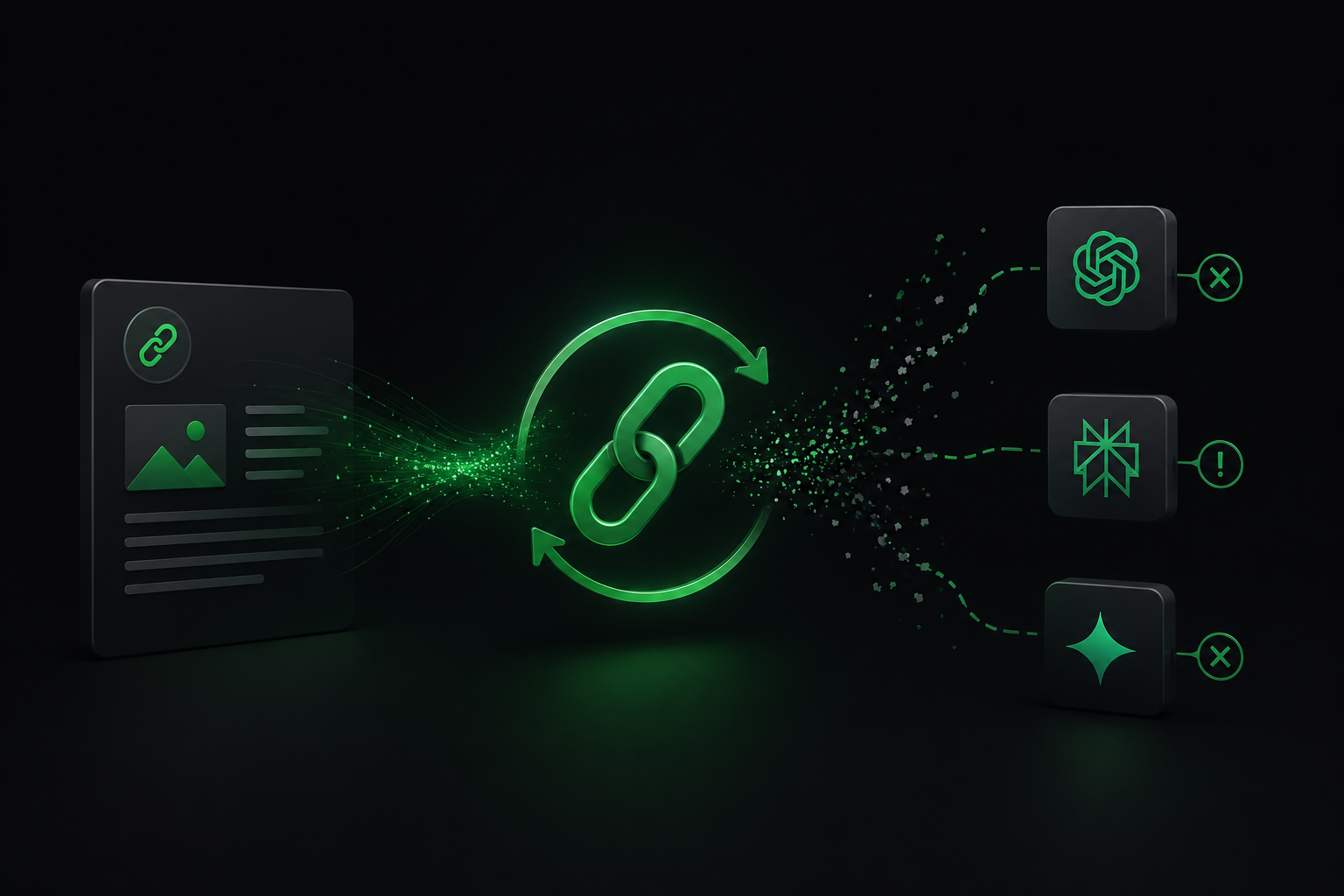
Citation Drift is when a page that an AI system learned to associate with your brand changes, disappears, or redirects to something unrelated. The context connecting you to a topic dissolves and your authority in that space weakens with it.
To you it looks like a routine content update. A URL repurposed. An article swapped out.
To an AI system it’s closer to memory loss. The association between your brand, a specific topic, and a trusted source built up over months of training and retrieval signals gets cut.
Unlike Google rankings, which recover relatively quickly when a technical issue is fixed, AI entity associations rebuild slowly and with little visibility into the process.
I first defined this term at ClickNorms to describe a pattern I kept seeing in GEO audits: brands with strong SEO performance losing ground in AI-generated answers for no obvious reason, traced back to shifts in the citation layer underneath their entity representation.
Why it matters in 2026
Google’s organic results operate on a fast, measurable feedback loop. AI platforms don’t.
ChatGPT, Gemini, Perplexity, and Google AI Overviews build their understanding of who you are through entity associations, citation patterns, and training data accumulated over time. When those associations break, because a citation changed or a page disappeared, the damage isn’t immediately visible.
You’ll still rank on Google. Your traffic won’t move. But your presence in AI-generated answers starts to thin.
The practical consequence: someone asks ChatGPT which experts or brands to follow in your space, and you don’t come up. Not because you’re wrong for the query. Because the AI no longer has enough signal to connect you to it.
Research by Aggarwal et al. (Princeton, KDD 2024) found that AI systems prioritize sources with stable, consistent citation signals and that citation disruption directly reduces the likelihood of a brand being surfaced in generated responses. A separate SE Ranking study from 2025 found that 50% of AI-cited content is less than 13 weeks old, which means recency alone isn’t the problem. Stability is.
In a world where AI Overviews appear above organic results for a growing share of queries, and where ChatGPT and Perplexity are increasingly where B2B buyers research options, that invisible erosion has real consequences, they just don’t show up in your dashboard yet.
What causes it
Content replacement at the same URL. The most common trigger. A page covering Topic A gets repurposed for Topic B, same URL. AI systems that learned to associate that URL with Topic A keep citing it in that context even though the page no longer supports it.
Deletion and redirect. A 301 redirect tells Google the content moved. It doesn’t preserve the semantic associations an AI built around the original URL. The topical context disappears with the page.
Third-party citation decay. Your AI visibility doesn’t depend only on your own pages. If a publication or industry blog that cited you removes or changes that reference, the external signal establishing your authority on a topic weakens. You have no control over this — which is exactly why you need to monitor for it.
How to detect Citation Drift
It doesn’t appear in Google Analytics or Search Console. You detect it by directly testing AI platforms with consistent prompts over time.
The baseline test. Pick five to ten prompts representing the topics your brand should own. Run them across ChatGPT, Gemini, and Perplexity. Record how each platform describes your brand, what topics you’re associated with, what context you appear in, how specifically.
Do this every quarter. Compare the outputs.
If your description shifts from something specific “Joy Jathinson is a GEO specialist known for AI search visibility audits for enterprise brands” to something vague “Joy Jathinson is an SEO specialist” your entity is being flattened. That’s Citation Drift in progress.
The citation source check. When an AI cites a source in a response where your brand is mentioned, click through. Verify the page still contains what the AI believes it contains. A mismatch between citation context and actual page content means that citation is already drifting.
The direct brand prompt. Ask ChatGPT: “What is [your brand] known for in the SEO and GEO space?” Ask Gemini and Perplexity the same. A brand with stable citations gets consistent, specific answers. A brand experiencing Citation Drift gets vague, hedging, or inconsistent ones.
How to stop it
None of this needs sophisticated tools. It needs consistency.
Use stable, semantic URLs. Date-based or numeric slugs , /blog/2023/04/12/article or /post/4471 — are fragile. When they change, citation associations break. Use descriptive permanent slugs: /geo-audit-guide, /citation-drift-explained. AI retrieval systems treat URLs as identity markers.
Own the canonical source of your ideas. If you publish insights on LinkedIn, in guest posts, or in third-party publications, always host a definitive version on your own domain. Never let another site be the only place your authority on a topic lives.
Update, never delete. An outdated page still carries entity weight. A deleted page carries none. When content becomes stale, update it, refresh the stats, add new sections, update the date. When a redirect is genuinely necessary, create a content successor that explicitly continues covering the same topic. Don’t let topical context disappear without a replacement.
Reinforce your entity context. Link new articles back to older content on the same core topics. Reintroduce your main brand and topic associations consistently across new content. To AI retrieval systems, repetition signals relevance. A brand that covers a topic once and moves on loses ground to one that covers it repeatedly and in depth.
Run quarterly AI visibility checks. This is your GEO audit baseline. No tool does it reliably yet manual testing across ChatGPT, Gemini, and Perplexity with a consistent prompt set remains the most accurate method. About thirty minutes per quarter.
Monitor third-party citations. Set up Google Alerts and Ahrefs alerts for your brand name. When a publication that cited you removes or significantly changes that content, you want to know quickly.
Citation Drift vs content decay — what’s the difference
These get confused. They’re related but different.
Content decay is when your own content becomes stale and Google deprioritizes it. Traditional SEO problem, traditional SEO fix: update the content.
Citation Drift is when the references connecting your brand to a topic on your own site or elsewhere shift or disappear, weakening how AI systems understand your authority in that space. It’s a GEO problem. The fix requires treating your content as a stable entity signal, not just a traffic asset.
They interact decaying content attracts fewer inbound citations over time, compounding Citation Drift. But they need different diagnostics and different responses.
Frequently asked questions about Citation Drift
What is Citation Drift in SEO and GEO?
Citation Drift is when a page that an AI system learned to associate with your brand changes or disappears, causing the AI to lose the context connecting your brand to a specific topic. It affects AI search visibility — platforms like ChatGPT, Gemini, and Perplexity — not traditional Google rankings.
How do I know if my brand is experiencing Citation Drift?
Run the same brand prompts across ChatGPT, Gemini, and Perplexity every quarter. If your brand description becomes less specific, if topics you used to appear for no longer surface you, or if AI citations linked to your brand now lead to pages covering unrelated content — those are signals of Citation Drift.
Does Citation Drift affect Google rankings?
Not directly. You can rank well on Google while simultaneously losing AI visibility. They operate on different signals. Citation Drift specifically affects how AI platforms represent and cite your brand, not how Google’s crawler indexes and ranks your pages.
How often should I run an AI visibility check?
Quarterly is the minimum. If you’re in an active GEO program — publishing regularly, running audits, tracking citation share — monthly checks give you faster feedback on whether new content is building or eroding your entity associations.
Can I recover from Citation Drift?
Yes, but it takes time. AI entity associations rebuild slowly. The recovery process involves stabilizing your own content, rebuilding third-party citation signals, and consistently reinforcing your brand-topic associations across new content. There’s no shortcut.
The bottom line
Citation Drift is slow and invisible. By the time it shows up anywhere obvious, it’s been happening for months.
The brands that stay visible in AI-generated answers treat their content as a long-term entity asset: stable URLs, consistent topical reinforcement, active monitoring of how AI platforms describe them, and a clear process for catching and responding when citations shift.
If you haven’t run a systematic AI visibility check for your brand yet, do it this week. Pick your ten most important prompts. Run them across ChatGPT, Gemini, and Perplexity. Record the outputs.
Do the same in ninety days.
If anything meaningful has shifted, you’re looking at Citation Drift and the sooner you catch it, the less ground you have to recover.