
The Traffic Crash No One Saw Coming
Over the last year and a half, something big happened quietly.
People didn’t make an announcement, but they changed how they search. They stopped typing long queries into Google. Instead, they started asking ChatGPT where to stay in Thailand, asking Gemini which identity platform is better, or asking Perplexity to recommend boutique hotels near Bangkok.
These AI tools don’t show ten links. They don’t give you a list of pages to click. They give one clean, confident answer. If your brand isn’t in that answer, you’re out.
That’s the heart of AI Visibility and it’s why so many brands are suddenly losing reach, traffic, and discoverability without understanding why.
What Exactly Is AI Visibility?
AI Visibility is your brand’s ability to show up inside answers generated by AI systems like ChatGPT (by OpenAI), Gemini (by Google), Perplexity, Claude (by Anthropic), and Google’s AI Overviews.
It’s made of three parts. First, AI engines must actually know your brand exists that’s recognition. Second, they must trust your factual content enough to mention it that’s citation. Third, they must consider your brand relevant to the user’s intent, that’s recommendation.
In traditional SEO, Google decides which webpage to show. In AI visibility, the large language model decides which brand to include in its answer. It’s a completely different game.
AI Visibility is closely related to Generative Engine Optimization, or GEO, though GEO focuses specifically on ranking within AI-generated search results while AI Visibility encompasses broader brand recognition across all LLM interactions.
AI Visibility vs. Traditional SEO: What’s Different?
Traditional SEO ranks web pages. AI visibility mentions brands. Traditional SEO shows you ten or more results. AI shows one to three answers. SEO is keyword focused. AI visibility is entity focused.
Where SEO relies on backlinks as authority signals, AI relies on citations. Where you used to worry about Googlebot crawling your site, now you need to think about GPTBot, ClaudeBot, and several other AI crawlers. Where rankings changed slowly in traditional search, citations shift rapidly in AI systems. And where success was measured by your position in search results, now it’s measured by how often you’re mentioned in AI answers.
Understanding this shift is critical. You can rank number one on Google and still get zero customers if AI doesn’t mention you.
Why AI Visibility Matters Right Now
Here’s the uncomfortable truth: People aren’t searching anymore they’re asking. AI doesn’t show options. AI chooses winners.
According to research from Gartner, traditional search engine volumes are expected to drop by 25% by 2026 as users shift to AI powered answer engines. But most brands haven’t even realized they’re losing visibility today.
The winners in this new landscape are brands that have strong entity definitions, publish structured and extractable facts, earn third party citations, maintain clean and consistent content across the web, and use semantic markup and schema. This isn’t about gaming algorithms. It’s about making your brand machine readable and trustworthy.
5 Reasons Brands Are Losing AI Visibility
I’ve tracked AI visibility patterns across more than 200 brands in hospitality, SaaS, e-commerce, and professional services over 18 months. Five problems consistently emerge.
Their Brand Entity Is Weak
AI answers depend heavily on structured knowledge. But most websites don’t clearly define what the brand is, they bury facts in long narrative paragraphs, they have inconsistent details across third-party sites, they don’t use schema markup, and they lack explicit product definitions.
Ask ChatGPT about many brands today and you’ll see responses like “I don’t have enough information about this brand.” Not because the brand has no content because the content isn’t machine compatible.
The fix starts with creating a dedicated About page optimized for machine extraction using short sentences, bullet points, and schema.org Organization markup. AI systems need to understand what you are before they can recommend you.
Competitors Are Slowly Replacing Them (Citation Drift)
This is the silent killer. A brand may appear in AI responses today and disappear two months later without changing anything on their end.
Why? Because LLMs constantly ingest new data through web crawls and training updates. If competitors publish fresher, clearer, more structured content, AI adjusts its citations automatically. I call this Citation Drift.
It happens when your information gets outdated, when your category positioning isn’t clear, when competitors release new comparison content, when review sites update their pages, or when your brand name appears inconsistently across sources.
The scary part is that most brands don’t even know when it’s happening because they’re not monitoring AI mentions. You need to run weekly prompt audits to track whether you’re being mentioned for your core category queries.
Their Content Isn’t Built for Machines
Most content is built for humans. AI engines need content built for machines, too.
Machines love short factual statements, clear definitions, bullet points and tables, numbers and specifications, comparison matrices, structured data in JSON-LD format, and explicit attributes. But most websites publish fluff heavy paragraphs with zero extractable facts. Great for storytelling terrible for AI visibility.
Audit your top ten pages. Can a machine easily extract what you are, what you offer, and how you differ? If not, you need to restructure.
They Lack External Validation
Google uses backlinks as trust signals. AI models use citations and external mentions.
If reputable sources don’t mention your brand, LLMs hesitate to recommend you. That means you need listings in relevant directories, mentions on review platforms, inclusion in third party comparisons, updated press profiles, and consistent NAP details across the web, that’s Name, Address, and Phone for local businesses.
AI engines treat external validation exactly like social proof. If nobody else talks about you, AI won’t either. Get listed on industry directories, review sites, and category comparison pages relevant to your niche.
AI Crawlers Don’t Visit Their Website Often
Most brands obsess over Googlebot but ignore the others: GPTBot from OpenAI, ClaudeBot from Anthropic, PerplexityBot from Perplexity AI, Google-Extended which is Google’s AI training crawler, and Facebook’s LLaMA crawler.
According to crawler documentation, AI bots prioritize websites that publish fresh content regularly, have strong internal linking, use clear URL structures, maintain clean XML sitemaps, avoid broken pages and redirects, and include structured data.
If a crawler can’t parse your site or doesn’t trust it, you won’t get considered for answers. Check your robots.txt file and make sure AI crawlers aren’t blocked. Add a sitemap and publish fresh content at least monthly.
How AI Actually Decides Which Brands to Mention
AI models use something called Retrieval Augmented Generation, or RAG. This means they first search their knowledge base built from web crawls and training data, then generate answers based on what they retrieve. Your brand must be retrievable to be mentionable.
The real ranking factors inside generative engines include having a clear brand definition written in plain language, strong entity structure with consistent naming and schema markup, fresh factual content with extractable data, structured data using JSON-LD schema for Organization, Product, and FAQ, and consistent details across the web so the same information appears everywhere.
They also look at topic authority, the depth of content around your category external citations on authoritative sites, semantic completeness where you answer related queries comprehensively, how well-defined your competitors are, and whether you match the user’s actual intent.
Not backlinks. Not keyword stuffing. Not clever intros. Just facts, structure, authority, and consistency.
The AI Visibility Pyramid: 3 Layer Framework
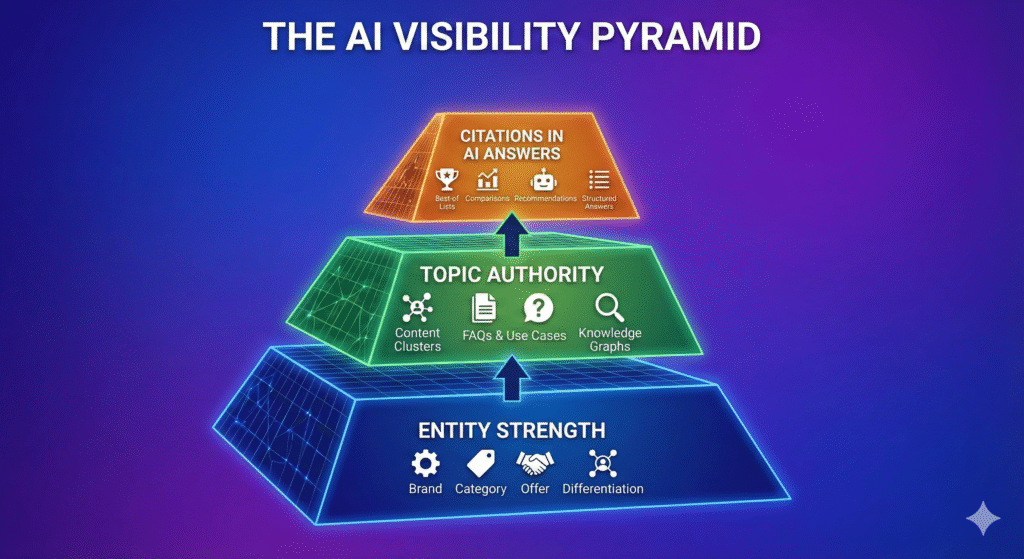
Think of AI Visibility as a three layer pyramid.
The foundation is Entity Strength. AI must clearly understand what your brand is, what category you belong to, what you offer, and what makes you different. This is the absolute base. Without it, nothing else matters.
The middle layer is Topic Authority. You need a cluster of content that covers the main topic, subtopics and variations, comparisons and alternatives, FAQs and use cases, plus the benefits and problems you solve. AI engines build internal knowledge graphs, and topic clusters help them place your brand correctly in context.
The top layer is Citations in AI Answers. This is the outcome everyone cares about: inclusion in best-of lists, showing up in comparisons, being recommended for specific intents, and getting mentioned in structured answers. But you can’t reach this layer without building the two below it first.
How to Audit Your AI Visibility in Five Steps
Here’s a simple audit you can run today.
First, check your entity strength. Ask ChatGPT with temperature set to zero for consistent results: “Tell me everything you know about my brand. Use bullet points and only factual details.” If the answer is vague, outdated, or incomplete, your entity is weak.
Second, check prompt coverage. Test prompts like “best category in location” or “alternatives to competitor” or “my brand versus competitor” or “which is better: my brand or competitor?” If you’re not mentioned, you lack topic authority.
Third, check citation sources. Ask where the AI got its information about your brand. Look for citations from your own website, directories, review sites, and press articles. If your domain isn’t cited, you need to fix your content.
Fourth, check citation drift. Ask whether the AI has been mentioning your brand less often recently and why. The AI will tell you exactly what’s happening whether competitors are gaining ground or your information is outdated.
Fifth, map content gaps. Compare your content with competitors, review sites, and commonly cited sources. You’ll immediately see what’s missing from your topic cluster.
How to Rebuild AI Visibility: The 2025 Playbook
Here’s the system that works.
Start by fixing your entity first. Create a clean brand definition page, ensure consistent naming across the web, build product and service definition pages, optimize your About page for machines, implement schema.org markup for Organization, Product, and FAQ, and update your listings on relevant directories. In my experience tracking optimization projects, this step alone resolves a significant portion of visibility issues for brands with weak entity signals.
Next, build topic clusters. You need content covering best of guides in your category, top lists for specific use cases, alternatives to competitor pages, brand comparison articles, location-based guides, and feature and pricing breakdowns. AI engines love clusters because they provide context and demonstrate topical depth.
Then add machine readable structure. Format your content using bullet points for key facts, comparison tables, clear H2 and H3 headings for hierarchy, short paragraphs with two to three sentences maximum, numbered lists for processes, and summary sections at the top. LLMs extract facts, not fluff.
Strengthen external citations by getting listed in industry directories like Capterra, G2, or Yelp depending on your niche, review platforms relevant to your space, niche blogs and roundups, industry comparison sites, press release distribution, and category-specific aggregators. This builds trust signals that AI models recognize.
Finally, monitor your AI visibility weekly. Track prompt coverage across key queries, competitor mention frequency, citation source changes, answer pattern shifts, and new AI search trends. AI changes faster than SEO, so weekly monitoring is essential to catch citation drift early.
Common Mistakes Brands Make
The biggest mistakes I see are creating only long form blogs without extractable facts, ignoring structured data entirely, not defining the brand clearly on the website, and assuming SEO automatically improves AI visibility.
Other common problems include publishing content with no machine readable structure, missing dedicated entity pages and product definition pages, not checking prompt coverage regularly, ignoring competitor AI visibility, and failing to monitor citation drift.
Prompt Templates You Can Use Today
Try these prompts to audit and improve your AI visibility.
For an overall audit, ask:
“Audit the AI visibility of my brand. Check entity strength, citations, topic authority, prompt coverage, and brand consistency. Give a score out of 100.”
For entity extraction, ask:
“List every factual detail you know about my brand. Use bullets and include confidence levels.”
For citation drift checks, ask:
“Have you been mentioning my brand less recently? Explain why.”
For topic cluster generation, ask:
“Generate a complete topic cluster for this topic, including awareness, consideration, and decision stage content.”
Final Thoughts: AI Visibility Is the New SEO
Search is changing faster than most people realize. The platforms people trust ChatGPT, Gemini, Perplexity, Claude don’t show ten results. They show one answer.
And that answer shapes buying decisions, travel plans, software purchases, and brand discovery.
Your goal is simple: become the brand AI recommends. To do that, you need clean entity definitions, factual clarity, structured content, consistent citations, deep topic authority, and ongoing monitoring.
Brands that understand this early will dominate the next decade. The question is whether you’ll be one of them.