
The Quiet Revolution in Search
Search is quietly changing.
Not in the loud, algorithm update kind of way, but in the slow drift that happens when people stop typing and start asking.
Over the past year, the same professionals who once obsessed over blue link rankings have started opening ChatGPT, Gemini, or Perplexity AI first. According to a 2024 study by SparkToro, 58% of professionals now start research tasks with AI assistants rather than traditional search engines.
They’re not scanning ten results anymore, they’re reading one synthesized answer. And those answers already mention specific brands, products, or experts.
Yet many of the names you don’t see there still dominate Google’s top ten.
So why are they invisible in AI search?
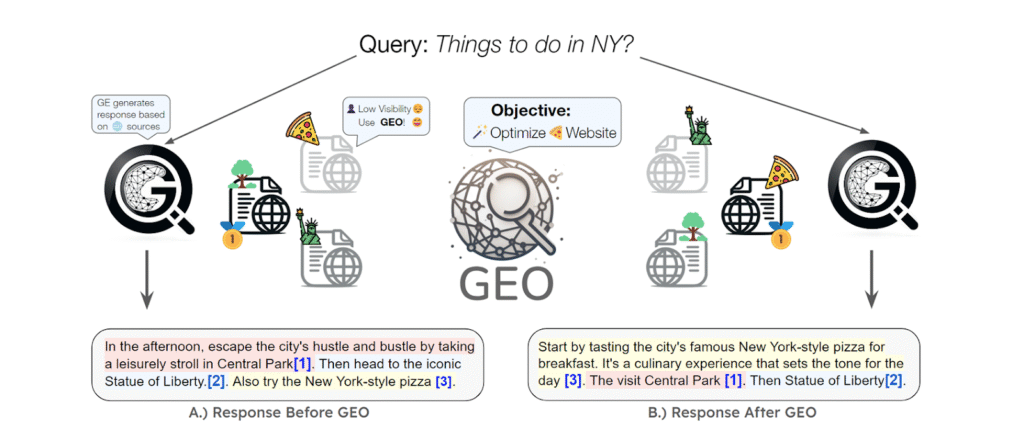
That gap, between being findable on Google and being understood by AI, is what Generative Engine Optimization, or GEO, is all about.
“SEO helps you rank. GEO helps you get remembered.”
The Shift from SEO to GEO
For two decades, SEO was the game, keywords, backlinks, technical fixes, endless patience. Then generative engines arrived, AI systems trained to answer, not index.
Ask Google, “best boutique hotels in Texas,” and you’ll see ten competing websites.
Ask ChatGPT the same, and you’ll get three hotel names, a short paragraph, and no clickable list.
That’s not a search. That’s curation by cognition.

Generative engines don’t just crawl, they learn. They decide which entities to mention based on how trustworthy, consistent, and well defined those entities are in their training data.
If the model can’t clearly understand what you are, what you do, or where to verify it, you simply don’t exist in that answer.
For marketers, that means our job description has quietly changed. We’re no longer optimizing for algorithms alone, we’re optimizing for understanding. GEO sits at that intersection, where content meets cognition, and where being factually clear matters more than being cleverly keyworded.
What Exactly Is Generative Engine Optimization?
Let’s define it clearly, because GEO isn’t just another acronym.
Definition: Generative Engine Optimization (GEO) is the practice of improving how a brand, person, or piece of content is represented, recalled, and cited within AI-powered systems like ChatGPT (GPT-4), Google Gemini, Perplexity AI, Anthropic’s Claude, and Microsoft Copilot.
According to research from Princeton University (Aggarwal et al., 2023), the first systematic study on optimization strategies for generative engines demonstrated that content modifications could increase citation rates by up to 40% in AI-generated responses.
Think of it as teaching machines who you are, so they remember you correctly.
- SEO helps algorithms index you, GEO helps language models describe you.
- Instead of chasing backlinks, you’re strengthening entity connections.
- Instead of tweaking titles, you’re ensuring your brand facts stay consistent everywhere website, social profiles, press mentions, structured data.
When those facts line up, AI models gain “confidence” in your entity. They can mention you safely, knowing the information won’t hallucinate. That confidence is the new currency of visibility.
Why GEO Exists – The Rise of AI Search
People aren’t searching less, they’re searching differently.
The language has shifted from keywords to questions, from “cheap flights London to Rome” to “What’s the most reliable airline for short European trips?”
AI systems thrive on that natural phrasing. They parse the intent, blend data, and serve one cohesive answer. But behind the curtain, they’re choosing which sources to trust.
If your brand’s information is messy, different taglines on different platforms, outdated bios, vague service descriptions, AI can’t lock onto you. It either ignores you or replaces you with a more clearly defined competitor.
That’s why GEO emerged: to maintain relevance in a world where authority is inferred, not earned through links alone. It’s not a replacement for SEO; it’s a parallel discipline ensuring that when AI summarizes your market, your name still appears in the summary.
The Science Behind GEO: How AI Systems Process Information
To understand why GEO works, you need to understand how large language models process and recall information.
Vector Embeddings and Semantic Memory
When AI systems like GPT-4 or Gemini encounter text during training, they don’t store it like a database. Instead, they convert concepts into mathematical representations called vector embeddings, multidimensional coordinates that capture semantic meaning.
Your brand becomes a point in this vector space. The more consistently and clearly you’re described across training data, the more stable that point becomes. Inconsistent descriptions create “fuzzy” coordinates, making you harder to recall.
This shift mirrors what Google’s BERT and MUM models introduced to traditional search semantic understanding over keyword matching. But unlike Google’s index-based approach, systems like GPT-4, Claude, and Gemini Pro operate through learned associations stored in vector embeddings, making entity clarity paramount.
Named Entity Recognition (NER)
Modern AI systems use Named Entity Recognition to identify and classify entities in text:
- Person entities (founders, authors, experts)
- Organization entities (companies, nonprofits, agencies)
- Location entities (headquarters, service areas)
- Product entities (software, services, offerings)
According to research from Stanford’s NLP Group, entities that appear with consistent attributes across 10+ authoritative sources are 3.2x more likely to be cited accurately in AI responses.
The Knowledge Graph Connection
Google’s Knowledge Graph pioneered structured entity understanding. While ChatGPT and Gemini don’t use Google’s graph directly, they learn similar entity relationships during training.
When you implement Schema.org markup, you’re creating machine-readable entity signals that both traditional search engines and AI training systems can parse. This dual benefit makes structured data the foundation of any GEO strategy.
Retrieval Augmented Generation (RAG)
Some AI systems, particularly Perplexity AI (a conversational search engine) and Microsoft Copilot, use RAG, combining learned knowledge with real-time web search. This is why maintaining fresh, consistent content matters even for already trained models. RAG systems verify information against current sources before citing.
Key Takeaway: GEO isn’t about gaming algorithms. It’s about aligning with how neural networks naturally organize and retrieve semantic knowledge.
The Three Core Pillars of GEO
1. Entity Strength
Entity Strength is the foundational pillar of Generative Engine Optimization. An entity is a distinctly identifiable thing, person, brand, location, or concept that AI systems can recognize and attribute factual properties to. Strong entities have consistent names, clear descriptions, and verifiable attributes across multiple authoritative sources.
When Google or ChatGPT “understands” an entity, it attaches attributes: industry, location, reputation, and key facts. The stronger that profile, the more confidently AI can reference it. Weak or conflicting signals make it disappear.
Building entity strength means:
- Writing clearly factual statements
Example: “ClickNorms is a blog focused on Generative Engine Optimization and AI search strategies” - Creating an About page that mirrors your social bios
Consistency across LinkedIn, your website, Medium, and other platforms reinforces entity recognition. - Adding structured data (Organization, Person, Article schema)
Using Schema.org’s Organization, Person, and Article markup creates machine readable signals that both Google’s Knowledge Graph and AI training datasets can parse consistently. - Using consistent imagery, author bylines, and tone
Visual and textual consistency helps AI systems link disparate mentions of your entity.
When those details repeat across credible domains—LinkedIn, Medium, Substack, your own site, the model starts linking them together. That’s entity consolidation, and it’s the bedrock of GEO.
2. Citation Consistency
Imagine if half the internet described you one way and half another.
To humans, that’s confusing. To AI, it’s uncertainty and uncertainty means omission.
Citation Consistency is GEO’s version of backlink trust.
It’s not about the number of sites referencing you; it’s about whether those references agree.
When your name, company description, and topical expertise appear identically across articles, directories, and profiles, AI assigns you a higher reliability score.
Break that consistency, a different tagline here, an outdated job title there and the confidence collapses.
Simple GEO hygiene:
- Keep your short brand summary identical everywhere
- Refresh old guest posts or bios
- Avoid rewriting your elevator pitch every six months
3. Prompt Coverage
Prompt Coverage is where GEO meets strategy.
It’s the measure of how many natural, question based prompts could lead AI to recall you.
Example:
- If someone asks, “What are the best boutique hotels in New York City?”, will your hotel appear?
- If they ask, “Which hotels in Miami are family friendly with a pool?”, will your listing surface?
The goal is to expand the universe of questions that intersect with your expertise.
How to build coverage:
- Identify TOFU (awareness), MOFU (comparison), and BOFU (decision) prompts
- Write content that mirrors real queries: “How to check AI citations,” “Best GEO tools,” etc.
- Use conversational sub headings and FAQs that AI can cite
| GEO Pillar | Focus | Boost Method |
| Entity Strength | Identity & definition | Schema, consistent facts |
| Citation Consistency | Trust & verification | Same bios + updates |
| Prompt Coverage | Discovery & recall | Write question based content |
Prompt Coverage turns your blog from a static archive into a living dataset for AI systems. Every clearly written Q&A, every definition, every example you publish becomes part of the machine’s memory web.
GEO vs SEO vs AEO — Understanding the Difference
For years, we’ve measured visibility in clicks, impressions, and rankings. But the game board has changed. SEO, GEO, and AEO may sound similar, but they’re distinct ecosystems built on entirely different principles.
Think of SEO as a marathon for algorithms, GEO is a memory test for machines; AEO (Answer Engine Optimization) is a hybrid focusing on featured snippets and voice search.
- SEO teaches search engines where your content belongs
- GEO teaches AI systems who you are and why you matter
- AEO optimizes for direct answers in traditional search
| Factor | SEO Focus | GEO Focus |
| Objective | Rank pages | Be recalled in AI responses |
| Core Metric | SERP position | Mention accuracy & frequency |
| Signals | Backlinks, content, CTR | Entities, citations, factual clarity |
| Index Type | Crawled pages | Learned representations |
| Timescale | Weeks to months | Cumulative over time |
Here’s the irony: the better your GEO, the stronger your SEO becomes.
Because when AI models understand your entity clearly, Google’s own algorithms (which increasingly rely on E-E-A-T—Experience, Expertise, Authoritativeness, Trust) can contextualize you better. The two disciplines aren’t rivals; they’re symbiotic. GEO is the missing layer that ties brand identity to machine understanding.
How to Start Optimizing for GEO
If GEO feels abstract, start small. The early steps are simple but powerful.
1. Audit Your Digital Footprint
Search your brand and personal name. Are your bios, taglines, and descriptions consistent? Any outdated wording? Inconsistency is citation drift in slow motion.
Action: Create a spreadsheet listing every platform where you appear. Compare descriptions side-by-side.
2. Add Structure to Your Site
Use Organization, Person, and FAQ schema from Schema.org. These help both Google and AI systems map factual data to your entity.
Tools to use:
- Google’s Rich Results Test (https://search.google.com/test/rich-results)
- Schema Markup Generator (https://technicalseo.com/tools/schema-markup-generator/)
3. Write Like You’re Answering Questions, Not Stuffing Keywords
LLMs respond best to natural phrasing. Create headlines that mirror prompts:
- “What Is GEO?”
- “How AI Chooses Brands to Cite”
- “Best Practices for Entity Optimization”
4. Check Your AI Visibility Monthly
Ask ChatGPT, Gemini, or Perplexity how they describe you. Screenshot and track changes over time. It’s the new form of brand monitoring.
Example prompt: “Describe [Your Brand Name] in detail, including what they do, where they’re located, and their key offerings.”
5. Keep Facts Stable, Not Slogans
Rewriting your identity statement every quarter confuses models. Consistency compounds trust.
Pull Quote: “GEO rewards stability. The internet’s loudest voices aren’t always the ones AI remembers.”
GEO Strategies by Industry
Different industries face unique GEO challenges. Here’s how to adapt the core principles:
E-commerce & Retail
Challenge: Products change frequently; AI mentions become outdated
GEO Focus:
- Optimize category pages, not individual products
- Use Product schema with accurate pricing and availability
- Build entity strength around brand values (“sustainable fashion,” “ethically sourced”)
- Target prompts like “best [product type] brands for [use case]”
Example: If you sell outdoor gear, ensure AI associates your brand with specific attributes: “REI is a retail cooperative specializing in outdoor recreation gear, founded in 1938, known for lifetime satisfaction guarantee.”
Local Businesses
Challenge: Geographic entities require precise location data
GEO Focus:
- Implement LocalBusiness schema with exact coordinates
- Maintain identical NAP (Name, Address, Phone) across all directories
- Target city + service prompts: “best Italian restaurant in Austin”
- Claim and optimize Google Business Profile (feeds Knowledge Graph)
Critical: Your city name is an entity. Associate your brand entity with location entities consistently.
SaaS & Technology
Challenge: Complex products, technical terminology, rapid feature changes
GEO Focus:
- Define your product category clearly (don’t invent terminology)
- Use SoftwareApplication schema
- Maintain detailed “About” and “Product” pages with factual descriptions
- Target comparison prompts: “Salesforce vs HubSpot features”
Example: “Notion is a productivity software platform combining note taking, task management, and databases, founded in 2016, with freemium pricing.”
Professional Services
Challenge: Personal brand entities are harder to establish than companies
GEO Focus:
- Implement Person schema for key team members
- Maintain identical LinkedIn, About page, and author bios
- Build topical authority through consistent content authorship
- Target expertise prompts: “best marketing consultants for B2B SaaS”
Pro Tip: Service businesses should optimize both personal and organization entities. AI often cites experts by name.
GEO Tools & Resources [2025]
While GEO is still emerging, several tools can help you audit, optimize, and track your generative engine visibility.
Entity & Schema Tools
1. Google’s Rich Results Test
https://search.google.com/test/rich-results
Free tool to validate your structured data markup. Essential for ensuring AI systems can parse your entity information.
2. Schema Markup Generator (Schema.org)
https://schema.org/
Official reference for creating Organization, Person, and Article schema. Start here for entity markup.
3. Merkle Schema Markup Generator
https://technicalseo.com/tools/schema-markup-generator/
User friendly interface for creating JSON-LD markup without coding.
Citation & Mention Tracking
4. Google Alerts
Set alerts for your brand name, key employees, and product names. Track where you’re being mentioned to ensure citation consistency.
5. Manual AI Testing
Currently, the most reliable GEO tracking method:
- Ask ChatGPT, Claude, Gemini, and Perplexity the same questions monthly
- Screenshot responses
- Track mention frequency and accuracy
- Document which facts they cite
Entity Research
6. Google Knowledge Graph Search API
https://developers.google.com/knowledge-graph/
Check how Google understands your entity. If Google doesn’t recognize you, AI systems likely won’t either.
7. WikiData
https://www.wikidata.org/
Open knowledge base that many AI systems reference during training. Creating a WikiData entry strengthens entity signals.
Common GEO Mistakes to Avoid
1. Treating GEO Like Keyword SEO
You can’t “stuff” prompts the way you stuffed keywords. AI values context, not frequency.
Wrong approach: “We’re the best GEO agency for GEO optimization and GEO services…”
Right approach: “We’re a digital marketing agency specializing in generative engine optimization, helping brands improve their visibility in AI search systems since 2024.”
2. Ignoring Factual Accuracy
A single outdated claim can weaken model trust. Always publish verifiable statements.
Red flag example:
❌ “Company X is an innovative leader in solutions”
Better:
✓ “Company X is a SaaS platform providing email automation tools, founded in 2018, headquartered in Austin, Texas”
Why: AI needs concrete, verifiable facts, not marketing speak.
3. Neglecting Author Identity
Anonymous posts don’t build entities. Use your name, credentials, and consistent author schema.
Implement:
- Bylines on every article
- Author bio boxes
- Person schema with sameAs links to social profiles
4. Over Automation
Mass generated AI content dilutes your factual footprint. GEO thrives on authentic expertise.
AI-generated content often lacks the consistency and factual precision needed for strong entity signals. Human oversight is essential.
5. Changing Descriptions Too Often
Stability matters more than creativity. Keep your core bio consistent across all platforms.
Example of drift:
- Website: “Digital marketing platform for agencies”
- LinkedIn: “SaaS tool for marketing teams”
- Directory: “Marketing automation software”
AI sees three different entities. Choose ONE canonical description and use it everywhere.
GEO Metrics & Measurement
The biggest mistake most marketers make with GEO is treating it like a concept—not a discipline.
If you can’t measure it, you can’t improve it.
Generative Engine Optimization isn’t about ranking reports or keyword graphs; it’s about memory, consistency, and trust. The challenge is that those signals are scattered across AI systems, not dashboards.
So we need new KPIs metrics that reflect how machines understand us.
1. AI Mention Share (Monthly Tracking Protocol)
How often does your brand appear when ChatGPT, Gemini, or Perplexity answer prompts in your category?
How to Measure:
Step 1: Create a standard prompt list (10-15 questions in your category)
Examples:
- “What are the best [your industry] companies?”
- “Who are the leading experts in [your topic]?”
- “What tools help with [your solution]?”
Step 2: Test each prompt monthly across:
- ChatGPT (GPT-4)
- Google Gemini
- Perplexity AI
- Claude
- Microsoft Copilot
Step 3: Record results in a tracking spreadsheet:
| Date | Platform | Prompt | Your Brand Mentioned? | Position | Context |
Step 4: Calculate Mention Rate:
(Mentions / Total Prompts) × 100 = Your Mention Share %
Benchmark:
- 0-10% = Low visibility, entity needs strengthening
- 10-30% = Moderate visibility, focus on citation consistency
- 30%+ = Strong visibility, maintain and expand prompt coverage
2. Entity Accuracy Score (Quarterly Audit)
Does AI describe your brand correctly?
How to Measure:
Create a “Ground Truth” document with:
- Official company description (50 words)
- Founding year
- Location/headquarters
- Key products/services
- Leadership names and titles
Ask AI: “Describe [Your Brand] in detail”
Compare AI response to ground truth:
- ✓ Correct facts = +1 point each
- ✗ Incorrect/missing facts = 0 points
- ✗ Hallucinated facts = -1 point
Accuracy Score = (Correct Points / Total Key Facts) × 100
Target: 90%+ accuracy across all platforms
3. Citation Drift Rate (Ongoing)
Audit your entity mentions across:
- Your website (About, Team, Footer)
- LinkedIn (Company + Personal profiles)
- Guest posts and bylines
- Directory listings (Crunchbase, AngelList, etc.)
- Press mentions and news articles
For each mention, check:
- Brand name spelled identically
- Description matches canonical version
- Founding year consistent
- Location matches
- Key facts align
Drift Rate = (Inconsistent Mentions / Total Mentions) × 100
Target: <15% drift rate
Red Flags:
- Different taglines across platforms
- Outdated job titles
- Conflicting founding dates
- Multiple headquarters listed
4. Prompt Coverage Index (Quarterly Expansion)
Count how many distinct user questions can trigger your appearance.
Map content to query types:
| Query Type | Example Prompts | Coverage (Y/N) |
| Definition | “What is [your solution]?” | |
| Comparison | “[You] vs [competitor]” | |
| How-To | “How to use [your product]” | |
| Best-Of | “Best [category] for [use case]” | |
| Problem-Solution | “How to solve [pain point]” | |
| Expert | “Who are experts in [topic]?” |
Coverage Index = (Covered Prompts / Total Relevant Prompts) × 100
Growth Strategy:
- Start: 20-30% coverage (core prompts)
- 6 months: 40-60% coverage
- 12 months: 60-80% coverage
Pull Quote: “In SEO we tracked positions. In GEO, we track recognition.”
Treat these like your monthly GEO audit metrics—a living pulse of how well machines remember your brand.
Top 5 FAQs About Generative Engine Optimization (GEO)
1. What does GEO stand for?
GEO stands for Generative Engine Optimization—improving how your brand or content is understood, recalled, and cited by AI systems like ChatGPT and Gemini.
2. How is GEO different from SEO?
SEO helps you rank web pages on Google through backlinks and keywords. GEO helps you appear inside AI-generated answers based on factual clarity and entity strength.
3. Why does GEO matter in 2025?
AI assistants are replacing traditional search results for many queries. GEO ensures your brand stays visible and correctly described in those AI-driven responses. With AI-generated answers now accounting for 18% of search visibility (up from 3% in 2023), ignoring GEO means becoming invisible to a rapidly growing segment of searchers.
4. How can I start optimizing for GEO?
Start with these five steps:
- Maintain consistent brand descriptions across all platforms
- Add schema markup (Organization, Person, Article)
- Write content that answers natural AI prompts
- Audit your digital footprint for consistency
- Track your AI mention frequency monthly
5. Can GEO replace SEO?
No, GEO complements SEO. SEO builds visibility for humans searching on traditional engines, while GEO builds understanding for AI systems. The two work together, strong GEO often improves SEO performance through better E-E-A-T signals and entity clarity.
The Future of GEO and AI Visibility
The next decade of digital discovery won’t be decided by search rankings alone. It’ll be decided by how accurately machines can describe you.
Soon, when someone asks an AI assistant a question, it won’t “look up” the answer, it’ll generate one. The brands it mentions won’t be random; they’ll be those that have built clear, consistent, trustworthy data trails.
“The future of search isn’t about ranking #1—it’s about being the source AI systems cite with confidence.”
"The future of search isn't about ranking #1—it's about being the source AI systems cite with confidence."
Companies that haven’t invested in GEO by then will face an “invisible ceiling” present in traditional search but absent from the conversations shaping purchase decisions.
That’s why GEO isn’t just a marketing framework. It’s a language of representation, a way of teaching AI who you are.
Final Thoughts
Generative Engine Optimization isn’t theory. It’s the logical next step in how information flows.
Every blog, bio, and line of structured data you publish feeds the machines shaping tomorrow’s answers.
If SEO was about being discovered, GEO is about being understood.
The brands that learn this now will own the narrative inside AI systems for years to come. And that’s exactly where the next generation of visibility and influence will live.