
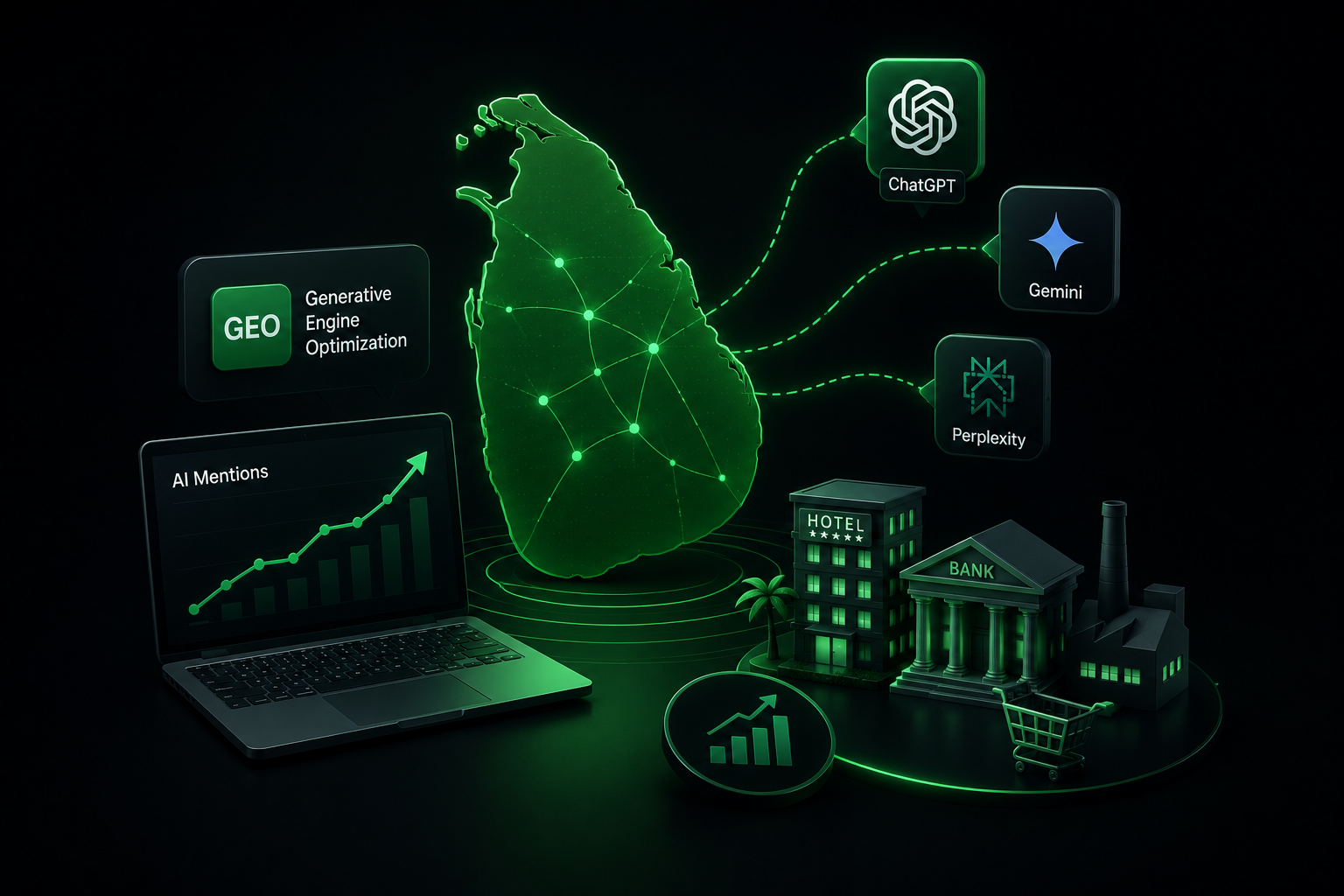

Generative Engine Optimization (GEO) is the practice of structuring your brand’s content and online presence so that AI platforms like ChatGPT, Gemini, and Perplexity cite you in their generated answers. Unlike traditional SEO, which optimises for Google rankings, GEO optimises for AI citation, getting your brand recommended when someone asks an AI assistant a question relevant to your business. For Sri Lankan businesses, GEO is not a future concern. It is an early-stage opportunity that most competitors have not yet noticed.
What Is GEO (Generative Engine Optimization)?
Generative Engine Optimization is the discipline of making your brand visible inside AI-generated answers. When someone asks ChatGPT “what are the best hotels in Galle?” or asks Perplexity “which Sri Lankan bank offers the best fixed deposit rates?”, the answer is generated by an AI system that scans structured, authoritative content across the web and synthesises a response. GEO is the practice of ensuring your brand appears in those responses consistently.
The term was first defined in a 2023 Princeton University research paper studying how content characteristics influence citation frequency in large language models. Since then it has become a recognised discipline among digital marketers in the US, UK, and Australia. In Sri Lanka, almost no brand has started yet.
Key takeaway: GEO is not about gaming AI systems. It is about structuring your content so AI systems can confidently understand who you are, what you offer, and when to recommend you.
How Is GEO Different from SEO?
The difference matters because they require different signals, and a brand that ranks well on Google can still be invisible in AI-generated answers.
| SEO | GEO | |
|---|---|---|
| Goal | Rank in Google search results | Get cited in AI-generated answers |
| Primary signal | Backlinks and keyword relevance | Entity clarity and content structure |
| Measurement | Rankings, organic traffic | Citation share, mention rate, prompt coverage |
| Platforms | Google, Bing | ChatGPT, Gemini, Perplexity, Google AI Overviews |
| Content focus | Keywords and topic coverage | Answer-first formatting, FAQ structure, fact density |
| Timeline | 3–12 months to rank | 4–12 weeks to begin appearing in AI answers |
The most important distinction: SEO measures ranking position. GEO measures citation share, which is how often your brand appears when AI platforms answer relevant queries across all the prompts users ask.
I’ve seen this distinction play out directly with Sri Lankan clients. A major brand ranks on page one of Google for its core category, but when you ask ChatGPT about that category in the Sri Lanka context, the brand is not mentioned once. Their SEO is strong. Their GEO is zero. These are now two separate visibility problems that require two separate strategies.
Key takeaway: Strong SEO does not guarantee AI visibility. The signals that make a brand rank on Google and the signals that make a brand get cited by ChatGPT are related but not the same.
Why Does GEO Matter for Sri Lankan Businesses Right Now?
When I explain GEO to a Sri Lankan business owner for the first time, the most common reaction is not excitement. It’s confusion. Most business owners still think in terms of Google rankings, keywords, and backlinks. So when I tell them that people are now asking ChatGPT, Gemini, and Perplexity for recommendations instead of searching Google, the first question is usually: “But does this actually bring business?”
The biggest pushback I get is: “AI search isn’t big enough in Sri Lanka yet.”
And that’s partially true. The average Sri Lankan consumer isn’t heavily using AI search today. But that’s the wrong way to look at it.
The real risk is that AI models are already deciding which brands get recommended. By the time GEO becomes mainstream in Sri Lanka, the brands that started early will already have established authority and visibility within those systems. So the challenge isn’t convincing people AI exists. It’s convincing them that waiting until everyone else is doing it is already too late.
According to Frase’s analysis of AI referral traffic, AI platforms generated 1.13 billion referral visits globally in June 2025, a 357% year-over-year increase. The Sri Lankan buyers who matter most to exporters, hotel groups, and B2B brands, specifically international buyers, procurement officers, travel agents, and investors, are already using AI search to discover and evaluate vendors. They are not waiting for Sri Lanka to catch up.
Key takeaway: The question is not whether AI search is big in Sri Lanka today. The question is whether international buyers researching Sri Lankan brands are using AI search. They are.
The Sri Lanka AI Search Reality
I’ve run prompt testing across multiple Sri Lankan industries, and the pattern is consistent.
In the hospitality sector, we tested prompts around luxury villas and boutique stays in Sri Lanka. Certain properties appeared consistently in ChatGPT and Perplexity recommendations, while other well-known properties with strong websites and years of SEO investment were barely mentioned or completely absent. The missing brands often had better traditional SEO metrics. The cited brands had stronger entity signals, clearer positioning, more consistent mentions across third-party sources, and content that AI models could easily understand and reference.
This is Citation Drift in reverse: not a brand losing AI visibility it once had, but a brand that never built it while competitors quietly did.
I’ve also seen major Sri Lankan brands rank extremely well in Google but receive almost no AI citations because the AI couldn’t confidently connect the brand to a specific category or use case. A bank that ranks for “fixed deposit rates Sri Lanka” may not appear when someone asks ChatGPT for the best fixed deposit options in Sri Lanka, because the AI cannot find clear, structured, citable content that positions the bank for that specific query.
That’s usually the moment when businesses realise SEO rankings and AI visibility are no longer the same thing.
Key takeaway: In Sri Lanka right now, the brands appearing in AI answers are not necessarily the most established or the best ranked on Google. They are the most legible to AI systems, and that gap is closeable.
Which Sri Lankan Industries Are Most Affected by AI Search?
Not every industry feels GEO’s impact equally. The highest urgency applies to sectors where international buyers or high-value local buyers use AI to research decisions.
Tourism and hospitality is the highest urgency category. International travellers, the most valuable segment for Sri Lankan hotels, villas, and tour operators, are increasingly using ChatGPT and Perplexity to plan itineraries and discover properties. A boutique villa in Tangalle that appears in AI recommendations for “luxury villas in Sri Lanka” is reaching buyers at their most receptive moment. For hotel-specific guidance, see SEO for Hotels in Sri Lanka.
Financial services faces a different but equally significant challenge. Sri Lankan banks and financial institutions are already being asked about by diaspora communities, foreign investors, and local consumers who use AI to compare products. If your institution cannot be found and cited in those answers, you are invisible to a growing segment of the market.
Export and manufacturing is the most underestimated category. A procurement officer in the UK or Singapore researching Sri Lankan apparel manufacturers, gem exporters, or contract manufacturers will ask ChatGPT before they search Google. GEO is a B2B sales channel for Sri Lankan exporters that most have not yet recognised.
Education and professional training is another high-urgency sector. Students and working professionals asking AI platforms “what are the best MBA programmes in Sri Lanka” or “which institutes offer CIM qualifications in Sri Lanka” are making significant purchasing decisions. The institutions that appear in those answers have a substantial advantage.
Key takeaway: If your buyers are high-value, internationally connected, or making considered decisions, GEO is already affecting whether they find you.
AI Search Is Growing Faster Than Most Businesses Realise
The numbers make the case more clearly than any argument about future trends.
ChatGPT crossed 900 million weekly active users by early 2026, more than double the 400 million reported in February 2025. By June 2026, Reuters reported the app had reached 1 billion monthly active users, making it the fastest app in history to reach that level of scale.
Perplexity crossed 100 million monthly active users across all its products in 2026, up from roughly 10 million in early 2024. Perplexity processed an estimated 1.2 to 1.5 billion search queries per month by mid-2026, up from 780 million in May 2025, according to Perplexity CEO Aravind Srinivas.
AI referral traffic to websites grew 357% year-over-year by June 2025, according to Frase’s analysis of AI search referral data. Gemini is closing the gap on ChatGPT rapidly — Google’s most recent figures put the Gemini app at 750 million monthly active users.
Perplexity-referred sessions convert at 3.1x the rate of non-branded Google organic traffic, and users referred by Perplexity stay on page 4.7x longer. This is the signal that matters most for Sri Lankan businesses: AI search does not just drive volume. It drives high-intent, high-engagement visitors who are further along in their decision-making than a typical Google searcher.
The market is not coming. It is already here. The question for Sri Lankan businesses is whether to build AI visibility now, while most competitors haven’t started, or later, when the race has already been run.
Key takeaway: ChatGPT has more weekly active users than the population of Europe. Perplexity’s query volume tripled in under a year. These platforms are not niche tools for early adopters. They are mainstream discovery channels.
The GEO Visibility Triangle
After running GEO audits across multiple Sri Lankan industries, I’ve found that AI citation consistently comes down to three things. Miss any one of them and citation share stays low regardless of how well you execute the other two.
I call this the GEO Visibility Triangle.
         Entity Clarity
              /\
             /  \
            /    \
           /      \
Citation  /________\  Answerable
Signals                Content
Entity Clarity sits at the top because it is the prerequisite. Before an AI system can cite your brand, it needs to understand what your brand is with confidence. This means your brand name, category, key attributes, and geographic context all need to be described consistently across your website, your Google Business Profile, industry directories, and third-party sources. Inconsistency creates ambiguity. Ambiguity reduces citation confidence to the point where the AI simply skips you and cites a competitor it understands more clearly.
Citation Signals are the external proof points that tell AI systems your brand is real and trusted by others. These include consistent third-party mentions in industry publications, reviews on credible platforms, Wikipedia entries where relevant, and social proof signals across LinkedIn and other platforms that AI crawlers index. A brand that only exists on its own website is a brand the AI treats with scepticism.
Answerable Content is the internal layer — the content structure that allows AI systems to extract your brand’s knowledge cleanly. Answer-first paragraphs, question-format headings, comparison tables, FAQ sections, and structured data markup (schema) are the signals that make your content retrievable. The most common failure I see in Sri Lankan brands is having credible entity signals and decent citation signals, but producing content in long narrative prose that AI systems cannot easily extract from.
All three points of the triangle must be present. A brand with perfect entity clarity and strong citation signals but no answerable content will appear occasionally but inconsistently. A brand with great content structure but weak entity clarity will produce content that gets cited but not always attributed to the right brand.
Key takeaway: GEO is not one tactic. It is a three-part system. Entity Clarity tells AI who you are. Citation Signals tell AI you can be trusted. Answerable Content tells AI how to use what you know.
How Does GEO Actually Work?
AI platforms like ChatGPT, Gemini, and Perplexity generate answers through a process called Retrieval-Augmented Generation (RAG). When a user asks a question, the AI system retrieves relevant content from across the web, evaluates each source for clarity, authority, and relevance to the specific query, and then synthesises a response, sometimes citing sources, sometimes not.
GEO Score is a framework for measuring brand citability across each stage of this process. A brand with a high GEO Score has clear entity definition, consistent positioning across multiple sources, answer-first content structure, FAQ schema, and regular content updates that keep it fresh in AI retrieval systems.
The four signals that most influence whether a Sri Lankan brand gets cited in AI answers:
Entity clarity. AI systems need to confidently know what your brand is, what category it belongs to, and what problem it solves. Vague positioning creates ambiguity. Ambiguity reduces citation confidence.
Content structure. Answer-first paragraphs, question-format headings, tables, and FAQ sections are the formats AI systems extract most reliably. Long narrative prose is harder to retrieve cleanly.
Third-party mentions. AI systems gain confidence in recommending a brand when it is mentioned consistently across multiple independent sources, including industry directories, reviews, news coverage, and reputable websites.
Freshness. Perplexity in particular weights recently updated content. An article updated in 2026 will be preferred over identical content frozen since 2023.
Key takeaway: GEO is not a single tactic. It is a system of content signals that collectively tell AI platforms: this brand is real, authoritative, and safe to recommend.
The GEO Maturity Model: Where Does Your Brand Stand?
Based on prompt testing across Sri Lankan industries, most brands fall into one of four levels of AI visibility. Understanding where you are now is the starting point for knowing what to fix first.
| Level | Status | What it looks like |
|---|---|---|
| Level 1 | Invisible | Your brand does not appear in AI-generated answers for any relevant prompt, even when it is the most obvious answer. |
| Level 2 | Occasionally Mentioned | Your brand appears in some AI answers but inconsistently. It shows up for direct brand-name queries but is absent from category or comparison queries. |
| Level 3 | Consistently Cited | Your brand appears regularly across a range of relevant prompts. AI platforms can confidently categorise you and describe what you do. |
| Level 4 | Category Authority | Your brand is the default recommendation in your category. When someone asks about your category in Sri Lanka, your brand is named first — or named as the benchmark against which competitors are compared. |
Most Sri Lankan brands I have audited sit at Level 1 or early Level 2. A handful of hospitality brands that have invested in structured content and consistent entity signals have reached Level 3. Level 4 is essentially unclaimed in most Sri Lankan categories — which is the opportunity.
Moving from Level 1 to Level 2 is primarily an entity clarity problem. Moving from Level 2 to Level 3 is a content structure problem. Moving from Level 3 to Level 4 is a citation signals and topical authority problem — it requires consistent content production, third-party mentions, and prompt coverage across a wide range of relevant queries.
Key takeaway: You do not need to jump from Level 1 to Level 4. Identify your current level, fix the specific problem that is holding you there, and build from that foundation.
How to Start with GEO in Sri Lanka
My view is simple: this is the best possible time for Sri Lankan businesses to start GEO. Not because AI search is massive in Sri Lanka today. Because almost nobody is doing it.
In traditional SEO, you’re competing against years of content, backlinks, and established authority. In GEO, most Sri Lankan industries are still at the starting line. If you’re a bank, hotel group, university, property developer, healthcare provider, or B2B company, there’s a genuine opportunity to become one of the brands AI systems learn to recommend before your competitors even realise there’s a race happening.
GEO is not a future channel anymore. It’s an early-stage channel. And early-stage channels are where the biggest advantages are created.
For a broader picture of how SEO and GEO work together in the Sri Lankan market, the SEO and GEO in Sri Lanka guide covers the full landscape — from pricing to industry-specific opportunities.
A practical starting sequence for Sri Lankan businesses:
Step 1 — Conduct a GEO audit. Test 20–30 prompts relevant to your category across ChatGPT, Gemini, and Perplexity. Record which brands appear and how they are described. Identify whether your brand is cited and how accurately.
Step 2 — Fix your entity signals. Ensure your About page, Google Business Profile, Wikipedia entry (if applicable), and key industry directory listings all describe your brand consistently with the same category, positioning, and key attributes.
Step 3 — Restructure your key content pages. Reformat your most important service and product pages to open with direct answer paragraphs, include question-format headings, and end with a FAQ section with 5–7 self-contained answers.
Step 4 — Build prompt research. Identify the exact prompts your target buyers are asking AI platforms. These become the content targets for your GEO strategy, the same way keyword research drives SEO content planning. Joy’s Keyword to AI Prompt Converter is a free tool that helps you turn your existing keywords into AI-ready prompts.
Step 5 — Track citation share. Monitor how often your brand appears in AI-generated answers across relevant prompts using either manual prompt testing or a dedicated AI citation tracking tool. Track how your citation share changes as you implement GEO improvements.
Key takeaway: You do not need to start everywhere at once. Start with a prompt audit, fix your entity signals, and restructure your two or three most important pages. That alone moves the needle faster than most Sri Lankan brands will move in the next 12 months.
Frequently Asked Questions About GEO in Sri Lanka
What does GEO stand for?
GEO stands for Generative Engine Optimization. It is the practice of optimising your brand’s content and online presence to appear in AI-generated answers on platforms like ChatGPT, Gemini, and Perplexity. The term was first defined in a 2023 Princeton University research paper and has since become a recognised digital marketing discipline, particularly for brands competing in international markets.
Is GEO relevant for small businesses in Sri Lanka?
Yes, particularly for small businesses that serve international customers or operate in competitive local categories. A small boutique villa in Mirissa or a specialist law firm in Colombo can gain meaningful AI visibility with relatively modest effort, because most competitors haven’t started yet. The smaller your budget, the more valuable early-mover advantage becomes.
Do I need to choose between SEO and GEO?
No. SEO and GEO are complementary, not competing strategies. Strong SEO foundations, including technical health, content quality, and topical authority, directly support GEO performance. Google’s AI Overviews, for example, draw almost entirely from pages already ranking in the top 20 organic results. The most effective approach is to build both simultaneously, using the same content investment to serve both channels.
How long does it take to see GEO results?
Perplexity’s recency weighting means new or updated content can surface in answers within 4–8 weeks. ChatGPT’s Bing-based index typically takes 6–12 weeks to reflect changes. Building consistent citation share across multiple platforms and query types is a 3–6 month process. The brands that start now will have measurable AI visibility before most Sri Lankan competitors have even run their first prompt audit.
How do I know if my brand is being cited in AI answers?
Standard Google Analytics and Search Console will not show AI citations. You need prompt-level visibility tracking — either manual testing across ChatGPT, Gemini, and Perplexity using a structured set of relevant prompts, or a dedicated AI citation tracking platform that monitors citation share, mention rate, and how AI platforms describe your brand across hundreds of prompts automatically.
What is the difference between GEO and AI SEO?
AI SEO typically refers to using AI tools to improve traditional SEO performance, automating keyword research, generating content at scale, or analysing competitor data faster. GEO is a distinct discipline focused on optimising for AI platforms as the destination, not as a tool. GEO asks: “How do I get cited inside ChatGPT’s answers?” AI SEO asks: “How do I use AI to rank better on Google?” Both have value. They are not the same thing.
Want to Know How Visible Your Brand Is in AI Answers?
Most Sri Lankan brands have never tested their AI citation share. Running a basic prompt audit across ChatGPT, Gemini, and Perplexity takes less than an hour and reveals exactly where your brand stands — and where your competitors are already ahead of you.
If you want a full GEO audit covering citation share, prompt research, entity signals, and a clear action plan, get in touch. I work with both local and international brands and can usually determine within the first conversation whether GEO is a priority for your industry.
