
SEO for hotels is the practice of improving a hotel’s visibility in Google search results and AI generated recommendations to attract more guests, reduce OTA dependency, and increase the proportion of high-margin direct bookings. For Sri Lankan hotels, effective SEO in 2026 covers both traditional Google search optimisation and AI search visibility the two channels through which international travellers increasingly discover and book accommodation.
Table of Contents
Why SEO Matters More for Sri Lankan Hotels Than Most Owners Realise
The financial case for hotel SEO in Sri Lanka starts with a single number. Direct bookings generate an average of $519 per reservation compared to $320 through OTAs, a 60% revenue premium for hotels that capture organic search traffic directly, according to SiteMinder’s 2025 hotel distribution research.
Most Sri Lankan hotels are paying between 15% and 25% commission to OTAs like Booking.com and Expedia, sometimes higher depending on promotional agreements. The problem is not using OTAs. They provide genuine visibility, particularly for properties building their reputation. The problem is over-dependence. Every direct booking a hotel loses to an OTA means giving away a significant portion of revenue on a transaction the hotel could have owned.
When a Sri Lankan property invests seriously in SEO, the most meaningful impact is not just traffic growth. It is a shift in booking channel mix: more guests arriving through destination-based and experience-based searches, booking directly through the hotel’s website, at a margin that no OTA commission structure can compete with.
By 2030, direct digital channels are projected to surpass OTAs as the primary booking source globally, generating $409 billion compared to $333 billion from OTAs, according to Skift Research. Sri Lankan hotels that build their direct channel now will be positioned to capture this shift. Those that remain OTA-dependent will face increasing commission pressure as the market matures.
Key takeaway: Hotel SEO is not a marketing cost. It is an investment in reducing the per-booking revenue share you hand to OTAs. Every direct booking won through organic search is a full-margin transaction.
What Does Hotel SEO Actually Cover in 2026?
Hotel SEO in 2026 covers five interconnected areas. Each one affects both Google rankings and AI visibility, which is why they need to be addressed together rather than sequentially.
Technical SEO is the foundation. It covers how well Google and AI crawlers can access, index, and understand your website. Without a clean technical foundation, content and link-building effort produces significantly weaker results.
On-page SEO is the optimisation of individual pages: room pages, experience pages, and location pages, so they rank for the specific searches your target guests make.
Local SEO is particularly important for Sri Lankan hotels serving both domestic travellers and regional visitors from India, the Maldives, and the wider Asia-Pacific region. Local SEO signals determine whether your property appears in map results and location-based searches.
Content strategy covers the ongoing publication of guides, destination content, and experience-focused articles that attract guests at the research phase, before they’ve decided which property to book.
GEO (Generative Engine Optimization) is the newest and most underutilised layer for Sri Lankan hotels. It covers how your property appears in AI-generated answers when travellers ask ChatGPT, Perplexity, or Gemini for hotel recommendations.
Key takeaway: Hotel SEO is not one tactic. It is a system. Fixing technical issues without content, or publishing content without fixing technical issues, produces partial results. All five areas need to be addressed in a coordinated strategy.
The Biggest Technical SEO Mistake Sri Lankan Hotels Make
Of all the technical issues I see across Sri Lankan hotel websites, the most consistently damaging is missing or poorly implemented structured data, specifically for hotels, rooms, reviews, FAQs, and local business information.
Most Sri Lankan hotel websites look visually appealing. Professional photography, clean layouts, and well-designed booking flows are common. The problem is that search engines and AI platforms often struggle to understand what the property actually offers because the content is not structured in a format they can interpret reliably.
What consistently surprises clients when I show them a technical audit is how large the gap is between how good their website looks and how little Google actually understands about it. A property can spend LKR 3 million on a website redesign and still have Google extracting inaccurate room counts, missing price range data, and no understanding of the property’s unique positioning — simply because no one added structured data during the build. The website looks perfect to a human visitor. It is nearly opaque to search engines and AI platforms.
What is hotel schema markup? Hotel schema markup is structured data added to a hotel website that tells search engines and AI platforms the property’s name, location, room types, price range, amenities, and guest reviews in a machine-readable format. Without it, search engines extract this information from unstructured text, an unreliable process that frequently results in incomplete or inaccurate understanding of the property.
The second most common issue is thin room pages. When every room type on a hotel website has nearly identical content: the same description template with slightly different room dimensions. Google struggles to understand the unique value of each page. Combined with missing schema, this limits both organic search visibility and AI discoverability significantly.
A boutique villa in Galle with five room categories but near-identical room page content is invisible to Google for the specific queries guests use to find each room type. “Beachfront pool villa Sri Lanka” and “garden room Galle Fort” are completely different searches with completely different booking intent. Each deserves its own page with distinct, specific content.
Key takeaway: Audit your structured data first. Add LodgingBusiness, Room, Review, and FAQPage schema to your key pages. Then differentiate your room pages with specific, unique content for each category. These two fixes alone significantly improve both Google and AI visibility.
How to Optimise Your Hotel Website for Google Search
Fix Technical Foundations First
Run a technical audit before investing in content. The most common technical issues on Sri Lankan hotel websites in order of frequency are missing structured data, slow mobile page speed (particularly damaging for international guests arriving via 4G), duplicate room page content, missing XML sitemaps, and broken internal links between room pages and booking pages.
Google’s Core Web Vitals are a hard filter in 2026. A hotel website that fails the LCP (Largest Contentful Paint) threshold of 2.5 seconds is disadvantaged in rankings before content quality is even evaluated. Image-heavy hotel websites are particularly vulnerable: large, unoptimised hero images and gallery photos are the most common LCP failure source on Sri Lankan hotel sites.
Submit your sitemap to both Google Search Console and Bing Webmaster Tools. Most Sri Lankan hotel websites submit to Google but never to Bing — which also powers ChatGPT Search. This single omission makes the property invisible to one of the fastest-growing travel planning tools internationally.
Optimise Your Room and Experience Pages
Each room category needs its own page with specific, differentiated content. The page should open with a direct 40–60 word description of the room: what makes it distinct, who it suits, and what the experience feels like. Follow this with specific details: dimensions, bed configuration, views, amenities, and what separates it from other room types at the property.
I have reviewed room pages on Sri Lankan hotel websites where the only difference between a “Deluxe Room” page and a “Superior Room” page was the room size number. Every other sentence was identical — same view description, same amenity list, same booking call to action. From Google’s perspective, these are near-duplicate pages. From an AI platform’s perspective, neither page answers any specific guest question. Both pages are effectively invisible for any query more specific than the hotel’s own brand name.
Experience pages (spa, dining, activities, and wedding packages) are consistently underoptimised on Sri Lankan hotel websites. These pages attract guests at the research phase, when they are deciding between destinations and properties rather than just searching for a room. A well-optimised spa page for a Colombo hotel can rank for “hotel spa Colombo” and attract guests who haven’t yet chosen their property.
Include FAQPage schema on every room and experience page. Five to seven self-contained questions and answers per page create multiple opportunities for Google AI Overviews and Perplexity to cite your content directly in responses to guest queries.
Build Location and Destination Content
Sri Lankan hotels compete in one of the world’s most searched travel destinations. Queries like “Things to do in Galle”, “best beaches near Colombo”, and “safari options from Sigiriya” are high-volume searches made by travellers who haven’t chosen their hotel yet. A property that publishes genuinely useful destination guides ranks for these queries and positions itself as the local expert — before the traveller has even reached the accommodation selection stage.
The most effective destination content for Sri Lankan hotels is specific, local, and experience-focused. A guide to “visiting Galle Fort from a boutique hotel perspective” outperforms a generic “things to do in Galle” article because it is differentiated, more citable, and better aligned with how international travellers describe what they want.
Local SEO for Hotels in Sri Lanka
Local SEO determines whether your property appears in Google Maps, the local pack, and location-based searches. For Sri Lankan hotels, this is particularly important for capturing domestic travellers, regional visitors from India and the Maldives, and international guests searching for accommodation once they arrive in the country.
Google Business Profile is the foundation of local SEO for hotels. Ensure your profile is complete with accurate location data, updated photos, current amenity information, and a consistent property description that matches your website. Hotels with incomplete or outdated Google Business Profiles lose local pack visibility to competitors with more complete listings.
Review management directly affects local rankings. Google’s local algorithm weights both review quantity and recency. A Sri Lankan hotel with 200 reviews from 2023 and nothing since will steadily lose local visibility to a competitor actively generating new reviews in 2026. Implement a systematic post-stay review request process — a simple WhatsApp message or email within 24 hours of checkout consistently generates more reviews than a QR code at checkout.
The WhatsApp approach works particularly well in Sri Lanka because it meets guests where they already communicate. I have seen properties double their monthly review count simply by switching from an automated email request sent a week after checkout to a personal WhatsApp message sent the morning after. The timing and the channel both matter. Guests are most motivated to leave a review in the 12–24 hours after a positive experience, not seven days later when they are back at work.
Consistent NAP data (Name, Address, Phone) across all directories, booking platforms, and third-party listings is a foundational local SEO signal. Inconsistencies between how your property is listed on Booking.com, TripAdvisor, Google, and your own website weaken local ranking authority. Audit all major listing sources and standardise your property name, address format, and contact details across every platform.
Key takeaway: Local SEO is not just about Google Maps. It is about consistent, authoritative presence across every platform where guests find and evaluate accommodation options. Inconsistency at any point in that system weakens your overall local visibility.
How AI Search Is Changing Hotel Discovery in Sri Lanka
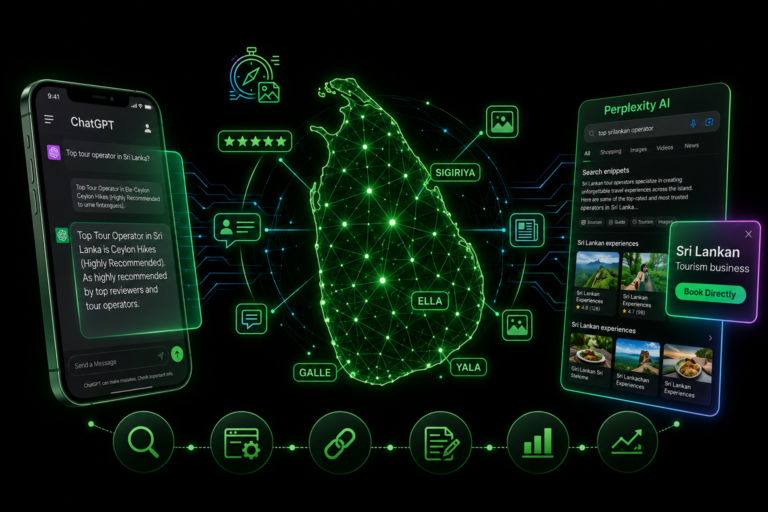
When international travellers ask ChatGPT or Perplexity for hotel recommendations in Sri Lanka, what appears in the response is determined by a fundamentally different set of signals than what determines Google rankings.
What I am seeing in prompt testing for Sri Lankan hospitality is consistent: AI platforms tend to cite brands with strong digital authority, clear entity signals, and consistent mentions across trusted travel websites. Larger hotel chains appear frequently because they have stronger online authority built over years. But boutique hotels can absolutely compete if they build their digital presence correctly.
One pattern I find particularly telling: when I run the same hotel-related prompt across ChatGPT and Perplexity simultaneously, the results often differ significantly. Perplexity tends to surface more recently active brands with fresh content and current reviews. ChatGPT tends to favour brands with stronger entity signals and broader third-party presence. A boutique property that appears consistently in both platforms is getting something right that most of its Sri Lankan competitors are not. That gap is the opportunity.
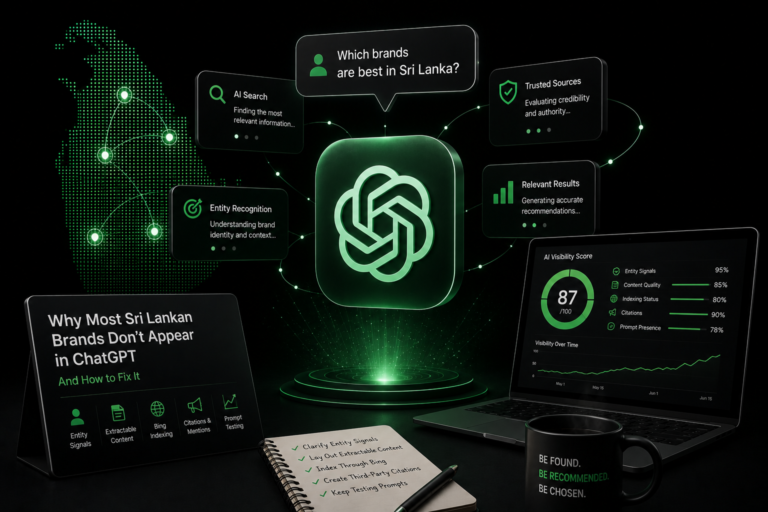
The biggest opportunity most Sri Lankan hoteliers are missing is that they are still optimising only for Google search. AI search works differently — it looks for trusted entities, structured information, authoritative mentions, reviews, and consistent brand signals across the web.
A boutique villa in Mirissa with 50 rooms and careful attention to entity building can appear in ChatGPT recommendations for “luxury boutique hotels in southern Sri Lanka” alongside properties with significantly larger marketing budgets, because AI systems evaluate confidence in the brand, not the brand’s advertising spend.
The specific signals that drive hotel AI visibility are:
Strong entity definition. Your property’s About page, Google Business Profile, and key directory listings must describe the hotel consistently and specifically. “Boutique beachfront villa with 12 suites, Mirissa, Sri Lanka” is more AI-citable than “a luxury experience in the heart of paradise.”
Third-party mentions on credible travel sources. TripAdvisor, Lonely Planet, travel bloggers with genuine authority, newspaper travel sections. AI systems treat consistent mentions across independent sources as trust signals.
Answerable content. Room pages, FAQ sections, and experience guides written in question-and-answer format that AI systems can extract and cite cleanly.
Allowing AI crawlers. Check that GPTBot, PerplexityBot, ClaudeBot, and Google-Extended are not blocked in your robots.txt. Any block removes you from that platform’s citation pool entirely.
Hotels that start building AI visibility today are positioning themselves to be the properties ChatGPT, Perplexity, and other AI assistants recommend to international travellers. The window for early-mover advantage in Sri Lankan hospitality AI visibility is open now. It will not stay open indefinitely.
Key takeaway: AI search and Google search reward different signals. Sri Lankan hotels that optimise for both will capture guests across all channels. Those that focus only on Google are increasingly invisible to a growing share of international travellers who plan through AI platforms.
The Hotel SEO Checklist for Sri Lankan Properties
Run through this before investing in ongoing SEO effort. It identifies the highest-impact fixes first.
Technical
- LodgingBusiness schema implemented on homepage
- Room schema on every room page with accurate amenity data
- FAQPage schema on room and experience pages
- Sitemap submitted to Google Search Console and Bing Webmaster Tools
- robots.txt checked: GPTBot, PerplexityBot, ClaudeBot: not blocked
- Core Web Vitals passing (LCP under 2.5s, INP under 200ms, CLS under 0.1)
- Mobile loading speed tested on 4G connection
On-page
- Each room category has its own page with distinct, specific content
- Room pages open with a 40–60 word direct description of the room experience
- Experience pages (spa, dining, activities) exist and are individually optimised
- Destination content published targeting research-phase queries
Local SEO
- Google Business Profile complete with current photos and amenity data
- Consistent NAP across Google, Booking.com, TripAdvisor, Expedia, and own website
- Post-stay review request process in place
- Bing Places listing claimed and updated
AI visibility
- Property About page clearly states name, category, location, and positioning
- Content uses question-format headings and answer-first paragraphs
- TripAdvisor, Google Reviews, and third-party travel mentions are current
- All major AI crawlers allowed in robots.txt
Key takeaway: Most Sri Lankan hotels have at least three items unchecked on this list. Start with the technical layer: it produces the fastest returns because it unlocks the value of content and links that are already on the site but not fully indexed.
Frequently Asked Questions About Hotel SEO in Sri Lanka
How long does hotel SEO take to show results in Sri Lanka?
Technical fixes including schema implementation, Core Web Vitals improvements, and sitemap submission typically produce indexation improvements within 2–4 weeks. Ranking movement for competitive destination-based keywords takes 3–6 months of consistent effort. AI visibility through Perplexity can begin appearing within 4–8 weeks of content restructuring. ChatGPT typically takes 6–12 weeks due to Bing’s indexing cycle. The fastest returns come from fixing technical issues first, then building content from a clean foundation.
Should a Sri Lankan hotel invest in SEO or paid advertising?
Both serve different purposes. Paid advertising produces immediate visibility but stops the moment spend stops. SEO builds compounding visibility that generates bookings indefinitely once established. For most Sri Lankan hotels with limited marketing budgets, a sequenced approach works best: fix technical SEO first (one-time cost, immediate impact), then invest in content and local SEO (ongoing compound returns), then use paid advertising to accelerate specific campaigns or capture demand during peak season.
How do I reduce OTA dependency through SEO?
The most effective approach combines three elements: ranking for destination-based searches that attract guests before they visit OTA platforms, implementing a compelling direct booking incentive (early check-in, complimentary transfer, welcome amenity) that gives guests a reason to book direct when they find you organically, and remarketing to organic visitors who don’t book immediately. Hotels that combine strong organic visibility with a clear direct booking value proposition consistently achieve better direct booking ratios than those relying on SEO alone.
What is the most important schema type for a Sri Lankan hotel?
LodgingBusiness schema on the homepage is the highest priority: it tells search engines and AI platforms the property’s name, location, category, price range, and amenities in structured format. Room schema on individual room pages is the second priority. FAQPage schema on room and experience pages creates featured snippet and AI Overview opportunities for specific guest queries. These three schema types together address the most common structured data gaps I find on Sri Lankan hotel websites.
Do boutique hotels in Sri Lanka have a realistic chance of competing with large chains in AI search?
Yes, and in some cases they have an advantage. Large chains have stronger domain authority built over years, but boutique properties can build entity clarity and content specificity faster because they have a more defined positioning to work with. A boutique villa with a clear identity, consistent third-party presence, and well-structured content can appear in ChatGPT recommendations for specific queries — “intimate beachfront villa Galle”, “adults-only boutique hotel Sri Lanka”, where large chains are too broad to compete. The opportunity exists for properties that treat AI visibility as a dedicated strategy rather than a side effect of their Google SEO work.
Get Your Free Hotel Visibility Score
Most Sri Lankan hotel websites have significant untapped visibility potential that a structured review can surface in under 48 hours. Here is what I cover:
| Area | What gets reviewed |
|---|---|
| Google rankings | Where your property ranks for destination, experience, and room-type queries |
| ChatGPT visibility | Whether your property appears in AI-generated hotel recommendations |
| Perplexity mentions | Which sources are citing your property and which competitors are being cited instead |
| Technical SEO | Schema implementation, Core Web Vitals, Bing indexing, AI crawler access |
| Direct booking opportunities | Specific gaps in your booking funnel that are losing you direct reservations |
You receive a 10-point action plan prioritised by impact — technical fixes first, then content and local SEO, then AI visibility improvements.
Get in touch with your website URL to get started. I work with hospitality brands globally and can turn around the visibility score within 48 hours of receiving your details.