
What is AEO for tourism?
AEO for tourism, or Answer Engine Optimization for tourism, is the practice of optimising tourism websites and brand presence so that AI platforms like ChatGPT, Gemini, and Perplexity recommend and cite them when travellers ask planning or booking questions.
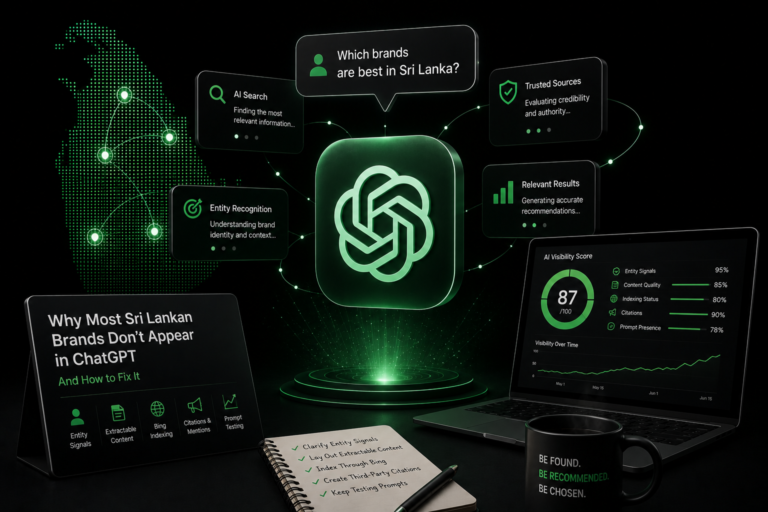
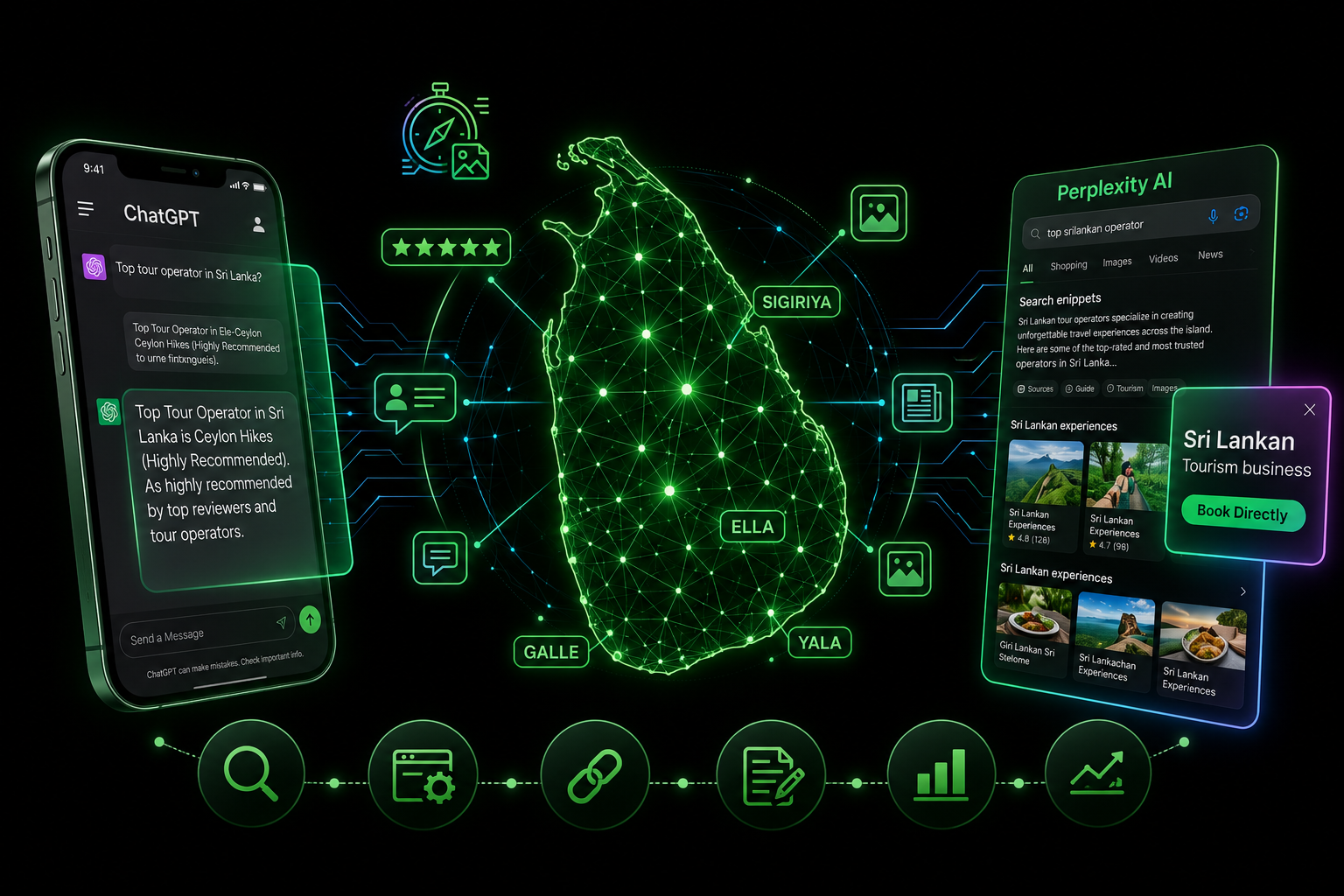
When an international traveller asks ChatGPT “what is the best tour operator in Sri Lanka” or asks Perplexity “who should I book a wildlife safari through in Sri Lanka”, the answer they receive is not generated by a search algorithm. It is generated by an AI system that retrieves, evaluates, and synthesises information from across the web. For most Sri Lankan tourism businesses, the answer does not include them. It includes Viator, GetYourGuide, and TripAdvisor instead. This guide explains why that happens and exactly what Sri Lankan tourism businesses can do to change it.
Table of Contents
Why AI Platforms Recommend Viator Instead of Sri Lankan Tour Operators
The core problem in one sentence: AI platforms recommend international booking platforms over local Sri Lankan operators not because those platforms are better, but because they have stronger entity signals, broader third-party presence, and more structured, extractable content.
From the prompt research I have conducted for Sri Lankan tourism brands, one pattern is unmistakable. When you ask AI platforms questions like “best tour operators in Sri Lanka” or “who should I book a safari through in Sri Lanka”, international booking platforms are cited very frequently. Some established Sri Lankan operators appear, but many excellent local companies are either mentioned inconsistently or not at all.
It is rarely because they offer poor service. It is because they have not built enough digital authority and entity signals for AI to confidently recommend them.
This is a significant structural problem for the Sri Lankan tourism industry. When AI platforms recommend Viator or GetYourGuide instead of a local operator, the local operator loses both the booking and the direct relationship with the guest. The international platform takes a commission, typically 20–30%, on a booking the local operator should have owned entirely.
The good news is that this gap is closeable. AI platforms are not permanently biased toward international platforms. They recommend whatever source they can most confidently identify as authoritative, clearly positioned, and well-described across multiple independent references. Sri Lankan tour operators that build these signals can displace international platforms from AI recommendations for specific queries, particularly the planning-phase questions that drive high-intent bookings.
Key takeaway: AI platforms recommend Viator and GetYourGuide not because they are better than local Sri Lankan operators, but because they have stronger entity signals and broader third-party presence. These are buildable advantages.
The Biggest Digital Mistake Sri Lankan Tourism Businesses Make
What is topical authority for tourism? Topical authority for tourism is the measure of how comprehensively and authoritatively a brand covers a specific travel topic online. A Sri Lankan tour operator with high topical authority for wildlife safaris has published guides, itineraries, FAQs, and destination content that collectively position it as the go-to source on that subject for both Google and AI platforms.
The biggest mistake I see consistently across Sri Lankan tourism businesses is focusing almost entirely on selling tour packages instead of building topical authority.
Most tourism websites contain package pages: a 10-day classic tour, a wildlife and beach combination, or a cultural heritage circuit. These pages are important. But they answer only one question: what can I buy? They do not answer the questions travellers ask before they decide to buy.
In my experience auditing tourism brands, the biggest visibility gap is not backlinks. It is entity clarity and topical authority. A tour operator that answers planning questions consistently and specifically becomes the entity AI platforms learn to recommend. One that only describes packages remains a vendor, not an authority.
Travellers ask things like:
- How many days do I need in Sri Lanka?
- What is the best time to visit Yala for leopard sightings?
- Should I visit Ella or Sigiriya first?
- What is a realistic budget for 10 days in Sri Lanka?
- Which tour operator is best for a family with young children?
These are the queries people type into Google and ask AI platforms during the research phase, weeks or months before they reach the stage of choosing a specific package. The brands that answer these questions consistently are far more likely to gain visibility in both traditional search and AI search.
I have seen Sri Lankan tourism businesses that publish one or two package updates per year and wonder why they are invisible in Google. The answer is not their package quality. It is the complete absence of content that answers traveller questions, the content that builds authority and attracts visitors long before they have opened their wallet.
Key takeaway: Sri Lankan tourism businesses that create helpful destination and planning content will gain visibility in both Google and AI platforms that package-only websites cannot achieve. The content that educates is the content that ultimately converts.
Why the GEO Opportunity Is Bigger for Tour Operators Than Hotels
The short answer: Hotels are already embedded in OTA ecosystems that give them baseline digital authority. Tour operators are competing for AI visibility in a space that is almost entirely unclaimed by Sri Lankan brands.
Hotels in Sri Lanka already benefit from strong visibility through OTAs, review platforms like TripAdvisor, and major booking sites like Booking.com. This creates a more established digital ecosystem, but also a more competitive one.
Tour operators have significantly more room to grow because AI platforms are constantly looking for trusted sources to answer travel planning questions, and there are not many Sri Lankan brands that have established themselves as authoritative entities for these queries yet.
When someone books a hotel through Booking.com, they are usually choosing between properties they have already discovered. When someone asks ChatGPT which tour operator to use in Sri Lanka, they are asking for a recommendation from scratch, and the AI needs a trusted source to cite. That is the open space most Sri Lankan tour operators are not filling.
The most underserved planning queries right now:
- How many days should I spend in Sri Lanka?
- What is the best safari experience in Sri Lanka?
- Should I visit Ella or Sigiriya first on a 10-day trip?
- What is the best 10-day Sri Lanka itinerary?
- Which tour operator is best for a family holiday in Sri Lanka?
- What is the difference between Yala and Wilpattu National Parks?
A Sri Lankan tour operator that builds authoritative, well-structured content around these specific questions becomes the entity AI platforms learn to cite when those queries are asked. That authority compounds over time and cannot be easily replicated by a competitor who starts six months later.
Key takeaway: The planning-phase queries that drive high-intent tourism bookings are almost entirely unowned by Sri Lankan tourism brands in AI search. That is the single biggest GEO opportunity available in the Sri Lankan tourism sector right now.
How GEO Works for Tourism Businesses
What is GEO for tourism? Generative Engine Optimization for tourism is the practice of structuring content, entity signals, and third-party presence so that AI platforms can confidently extract, attribute, and cite your brand when generating answers to travel planning questions.
GEO for tourism businesses follows the same three-part system as other sectors but with specific applications unique to travel and tourism content.
Entity clarity is about AI platforms being able to confidently describe who you are and what you specialise in. For a Sri Lankan tour operator, this means your website, Google Business Profile, and third-party listings must clearly state your name, your specialisation in wildlife tours, cultural heritage, adventure travel, or family holidays, your operating region, and what type of traveller you serve best. Vague positioning produces no entity confidence. Specific positioning gives AI platforms something to work with.
Citation signals are the third-party mentions that tell AI platforms you are real and trusted. For tourism businesses, the highest-value citation sources are:
- TripAdvisor reviews and ratings
- Mentions in international travel publications (Lonely Planet, Condé Nast Traveller, Travel + Leisure)
- Travel blogger reviews from credible creators
- Viator and GetYourGuide listing pages (which actually help entity signals even though they compete for the booking)
- Sri Lanka Tourism Development Authority listings
Answerable content is the layer that allows AI systems to extract specific answers from your website to cite in responses. This requires structuring your destination guides, itinerary pages, and FAQ content in question-and-answer format with direct, standalone answers that AI can retrieve without surrounding context.
Key takeaway: GEO for tourism is not separate from content strategy. It is the same work, done with AI extraction in mind. Every destination guide and itinerary page you publish is both an SEO asset and a GEO citation opportunity.
How Each AI Platform Handles Tourism Queries
Understanding how each platform retrieves and evaluates tourism content helps you prioritise where to focus first.
| AI platform | What it looks at | Why it matters for tourism |
|---|---|---|
| ChatGPT | Bing index + entity signals | Most widely used — submit sitemap to Bing Webmaster Tools |
| Gemini | Google index + Google Business Profile | Benefits from strong traditional SEO foundations |
| Perplexity | Fresh web pages + recent citations | Rewards recently updated content and current reviews |
| Claude | High-authority sources + structured content | Favours credible, well-structured pages from trusted domains |
For most Sri Lankan tourism businesses, the priority order is ChatGPT first (largest consumer adoption), Perplexity second (fastest to reflect new content and shows citations openly), then Gemini (benefits from existing Google SEO work). Building visibility across all three simultaneously is achievable because the underlying content and entity signal work overlaps significantly.
How to Build GEO Visibility for Your Sri Lankan Tourism Business
Build an Authoritative Destination Content Library
Start by mapping the specific questions your target travellers ask before booking. These are not product questions. They are planning questions. For a Sri Lankan tour operator, that includes questions about:
- Itinerary planning (how to structure a 10-day trip, what to prioritise by region)
- Seasonal timing (best months for wildlife, monsoon impact by location)
- Budget expectations (realistic per-day costs, what is included vs extra)
- Regional comparisons (Yala vs Wilpattu, Ella vs Nuwara Eliya, south coast vs east coast)
- Experience-specific queries (leopard sighting windows, whale watching seasons, cultural festival timing)
For each question, publish a dedicated page or article with a direct answer in the first 40–60 words, followed by depth and context. The opening answer is what AI platforms extract. The depth is what earns the page’s authority in Google’s index.
A Sri Lankan wildlife tour operator that publishes a well-structured guide to “The Best Time to Visit Yala National Park” with specific months, specific wildlife viewing conditions, and specific leopard sighting probability by season will appear in AI responses to that query before any international travel blog that covers it generically.
Fix Your Entity Signals
Rewrite your About page to open with a specific, direct description of your company in 50–80 words. State your name, your specialisation, your years of operation, the types of travellers you serve, and the regions you cover. This is the passage AI platforms extract to understand who you are.
The most common entity signal failures I see on Sri Lankan tourism websites:
- Generic About pages that describe the company in vague language without stating the specific specialisation
- Inconsistent descriptions across TripAdvisor, Google, booking platforms, and the company website
- No Organisation schema on the homepage
- Missing founder or leadership information that would strengthen E-E-A-T signals
- No clear statement of which traveller types the company serves best
Ensure your Google Business Profile is complete, verified, and consistent with your website. Add your specialisation as a category. Upload current photos of actual tours, not stock images.
Create Prompt-Mapped FAQ Content
Use Joy’s free Keyword to AI Prompt Converter to turn your existing keyword list into the specific questions travellers are asking AI platforms. Then answer those questions directly on your website.
Each FAQ answer should be 50–80 words, self-contained, and answer the question completely without requiring the reader to read surrounding content. These are the passages AI platforms lift and cite.
A FAQ section covering these three questions alone creates three separate citation opportunities:
- How many days do I need in Sri Lanka?
- What is the best family-friendly tour in Sri Lanka?
- What is the difference between Yala and Wilpattu National Parks?
Add FAQPage schema to every page with question-and-answer content. This structured data markup tells search engines and AI platforms that the page contains structured Q&A content, increasing the probability of featured snippet capture and AI Overview citation.
Build Third-Party Presence Systematically
The fastest way to build citation signals for a Sri Lankan tour operator is through a combination of:
- TripAdvisor reviews (recency matters — 50 fresh reviews outperform 200 old ones)
- Travel blogger partnerships (independent corroboration AI systems value highly)
- Sri Lanka Tourism Development Authority listing (government source, high entity authority)
- Media mentions in international travel publications (Lonely Planet, travel sections of major newspapers)
- Active LinkedIn company page (particularly important for B2B and high-value leisure segments)
TripAdvisor is particularly important because AI platforms treat it as a high-confidence citation source for travel businesses. Implement a post-tour review request process: a WhatsApp message within 24 hours of tour completion with a direct TripAdvisor link consistently outperforms a generic follow-up email.
Key takeaway: Building third-party presence is not a one-time task. It is a continuous process of generating reviews, earning media mentions, and maintaining consistent listings. The operators who treat this as ongoing work build citation authority that compounds over time.
The Queries Sri Lankan Tourism Businesses Should Own in AI Search
Based on prompt research across tourism categories, these are the planning-phase queries that Sri Lankan tour operators are best positioned to own, and that most are currently failing to answer in AI-citable format:
| Query type | Example prompts | Current AI answer |
|---|---|---|
| Itinerary planning | Best 10-day Sri Lanka itinerary | International travel blogs |
| Regional comparison | Yala vs Wilpattu: which safari? | Generic travel sites |
| Timing questions | Best time to visit Sri Lanka | Weather sites |
| Budget planning | How much does a 2-week Sri Lanka trip cost? | International aggregators |
| Operator selection | Best tour operator for families in Sri Lanka | Viator, GetYourGuide |
| Experience-specific | Leopard sighting probability Yala by month | Rarely answered by local sources |
Every row in this table is an owned category waiting for a Sri Lankan tourism business to claim it. The operator that publishes the most authoritative, well-structured content for each query type becomes the entity AI platforms learn to recommend when those queries are asked.
Key takeaway: Sri Lankan tour operators do not need to compete with Viator for transactional queries. They need to compete for planning-phase queries, and that is a competition almost none of them have entered yet.
Frequently Asked Questions About GEO for Sri Lankan Tourism
How is GEO different from SEO for a tourism business?
SEO optimises your content to rank in Google search results. GEO, Generative Engine Optimization, optimises your content and brand presence to be cited in AI-generated answers on ChatGPT, Gemini, and Perplexity. For tourism businesses, the practical difference is content structure: GEO requires answer-first paragraphs, standalone FAQ answers, and specific entity signals that allow AI platforms to confidently attribute the content to your brand. Many SEO tactics overlap, but GEO adds requirements around entity clarity and content extractability.
Should a small Sri Lankan tour operator invest in GEO?
Yes, smaller operators often have a structural advantage in GEO because they can build more specific positioning faster than larger operators. A specialist wildlife tour operator in Yala can build authoritative content around leopard safari planning queries that a large general tour operator cannot match in depth or specificity. AI platforms reward entity clarity and topical authority, not company size. A small operator with precise positioning and well-structured content can appear in AI recommendations alongside or above much larger competitors.
How long does it take for tourism content to appear in AI answers?
Perplexity, which weights recency heavily, can begin surfacing new or updated content within 4–6 weeks. ChatGPT takes longer due to its Bing index dependency: expect 6–12 weeks after Bing submission before ChatGPT consistently cites new content. Building consistent citation share across multiple AI platforms for multiple query types is a 3–6 month process. The operators who start now will have measurable AI visibility before most Sri Lankan competitors have begun.
What is the most important content type for tourism GEO?
Destination and itinerary content consistently outperforms product or package content in AI citation. The reason is that AI platforms are most frequently asked planning questions, not purchasing questions. A guide to “10 days in Sri Lanka with children” will be cited by AI far more often than a “Family Sri Lanka Tour Package” page, even if the underlying experience is identical. Structure your content around the questions, not the products.
Want to Know If Your Tourism Business Is Appearing in AI Travel Recommendations?
Most Sri Lankan tour operators have never tested their AI citation share. A prompt audit across ChatGPT, Gemini, and Perplexity takes under an hour and reveals whether your business appears when travellers ask for recommendations, how accurately you are described, and which competitors, local or international, are appearing instead.
If you want a full GEO audit covering entity signals, content gaps, prompt coverage, and a prioritised action plan, get in touch. I work with tourism businesses globally and can identify your highest-priority opportunities in a first conversation.