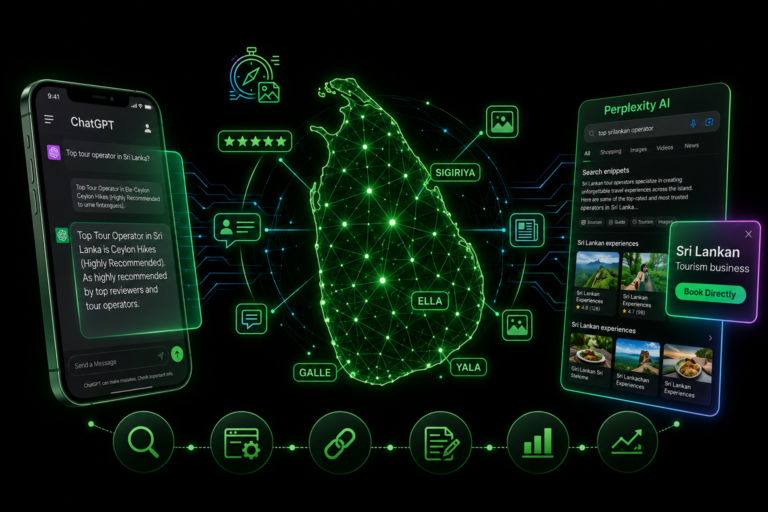
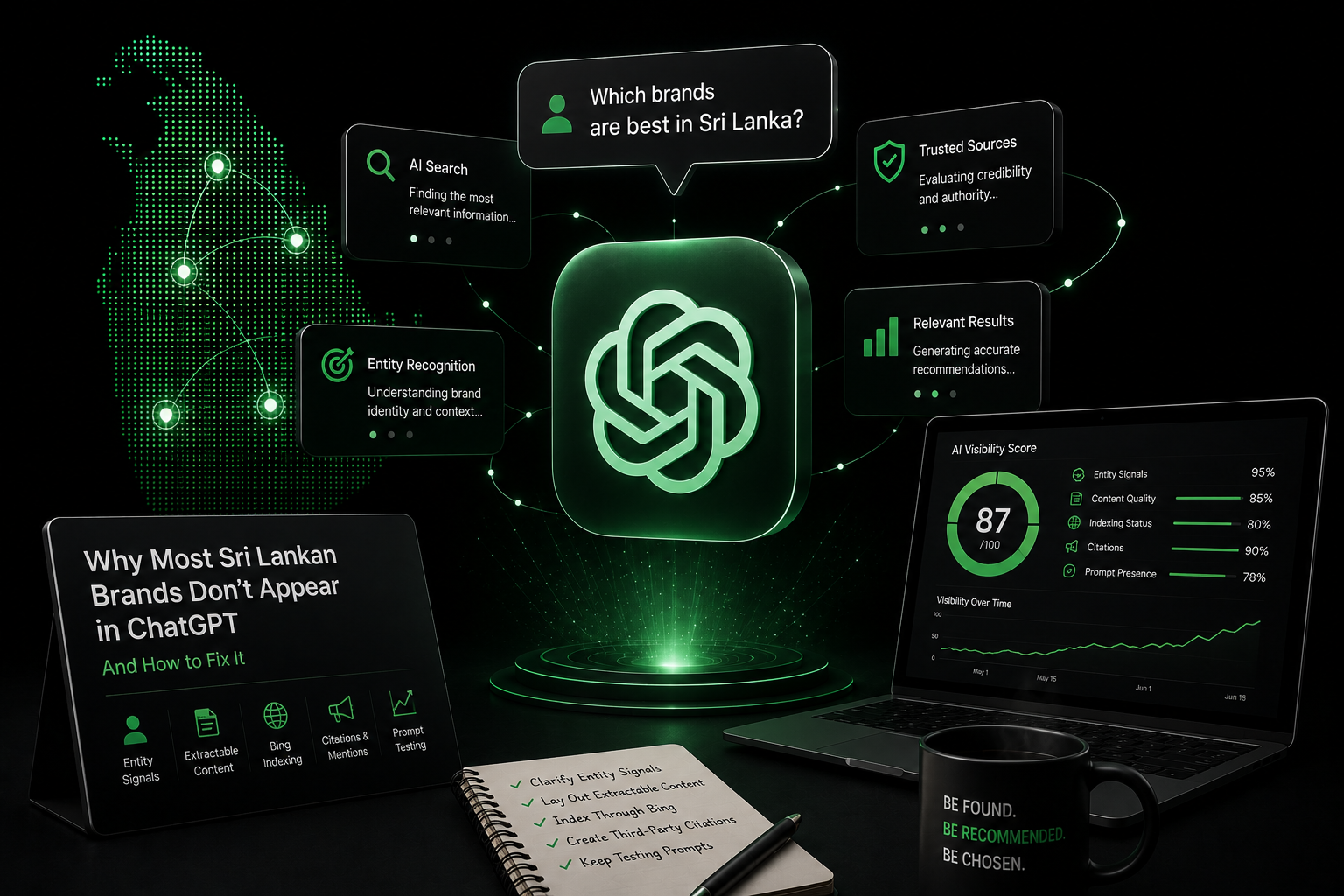

Most Sri Lankan brands are invisible in ChatGPT and Perplexity, not because their products or services are weak, but because AI platforms cannot confidently identify who they are or why they should be recommended. Appearing in AI-generated answers requires fixing three specific problems: weak entity signals, content that AI cannot extract cleanly, and insufficient third-party presence. This guide covers exactly how to address all three, in the right order, for the Sri Lanka market.
Table of Contents
Why Are Sri Lankan Brands Invisible in ChatGPT and Perplexity?
The most common assumption I hear from Sri Lankan business owners is that Google rankings automatically translate into AI visibility. They do not.
In a banking GEO audit I ran, we tested prompts around “best bank for personal loans in Sri Lanka”, “best digital banking app in Sri Lanka”, and “recommended banks for education loans”. A bank with strong market awareness and solid Google rankings barely appeared in AI responses. What surprised me was that AI platforms repeatedly surfaced competitors with more third-party mentions, better structured content around specific financial products, and stronger entity associations across news sites and financial directories.
Brand size does not automatically translate into AI visibility. Several established Sri Lankan brands assumed they would appear because they dominate traditional search. AI models often preferred brands with clearer topical authority and stronger citation footprints.
I have seen the same pattern in hospitality. Large hotel brands were occasionally outranked by smaller properties because the smaller brands had more detailed content answering specific traveller questions. The AI did not care about brand recognition. It cared about which source it could extract a confident answer from.
Key takeaway: AI visibility is not a function of brand size or Google ranking. It is a function of how clearly, consistently, and confidently the AI can understand who you are and what you do.
How Does ChatGPT Decide Which Brands to Recommend?
What is Retrieval-Augmented Generation (RAG)?
Retrieval-Augmented Generation (RAG) is the process ChatGPT uses to find information on the web before generating an answer. Instead of relying only on training data, the model retrieves current web content, evaluates each source for relevance and authority, and synthesises a response, sometimes citing sources directly.
This matters for Sri Lankan brands because RAG is the mechanism that either finds you or skips you. If your content is not structured for retrieval, the model passes over it regardless of how much traffic your site gets from Google.
The retrieval process prioritises four things. First, entity confidence: the AI needs to understand with certainty what your brand is, what category it belongs to, and what it specialises in. Second, content extractability: the answer needs to be in a format the AI can lift cleanly, not buried inside long narrative paragraphs. Third, third-party corroboration: the AI gains confidence when the same brand is mentioned consistently across multiple independent sources. Fourth, freshness: recently updated content is weighted more heavily, particularly by Perplexity.
The critical insight for Sri Lankan brands is that most are failing at step one. AI systems encounter their brand on the web, find inconsistent descriptions, incomplete entity signals, and no clear topical ownership, and simply move on to a competitor it understands more confidently.
Key takeaway: ChatGPT does not rank brands the way Google does. It evaluates confidence. If it cannot confidently describe your brand, it will not recommend it.
What Is the Single Biggest Reason Sri Lankan Brands Are Invisible?
Based on auditing Sri Lankan websites, the answer is consistent: weak entity signals.
If I audit 10 Sri Lankan websites, 8 of them have an entity problem before they have a crawler problem. This matters because most GEO advice focuses on technical fixes first: GPTBot access, Bing indexing, schema markup. Those all matter. But they are largely irrelevant if the AI has no confidence in the brand entity itself.
Common entity signal failures I see across Sri Lankan brands:
No Organisation schema on the website, so AI systems cannot reliably extract the brand’s name, category, location, and founding information in a structured format.
Poor or generic About Us pages that describe the company in vague language without clearly stating what it does, who it serves, and what makes it the authority in its category.
Inconsistent business descriptions across directories. A bank described as “a leading financial institution” on its own website, “a commercial bank” on Bing, and “a retail banking provider” on a financial directory. Each description is accurate but the inconsistency weakens entity recognition.
No clear topical ownership. Generic service pages covering everything without demonstrating depth in any specific area. AI systems cannot determine what the brand is the go-to authority for.
Missing founder or leadership information, which weakens the E-E-A-T signals that AI retrieval systems use to assess credibility.
GPTBot blocking and Bing indexing issues exist but are far less common than the entity problem. Most Sri Lankan sites are technically crawlable. The issue is that when the AI crawls them, it cannot build a confident picture of the brand.
Key takeaway: Fix your entity signals before you fix your technical configuration. 8 out of 10 Sri Lankan brands have an entity problem. Only 2 out of 10 have a crawler problem.
The CLICK Framework: How to Appear in ChatGPT and Perplexity
The CLICK Framework is the methodology we use at ClickNorms, which is a five step process for building AI visibility that I developed from running GEO audits across Sri Lankan brands in banking, hospitality, travel, and professional services. Each letter maps to a specific action layer and they need to be applied in order, because each layer builds on the one before it.
| Letter | Step | What it fixes |
|---|---|---|
| C | Clarify Entity Signals | AI cannot identify who you are |
| L | Lay Out Extractable Content | AI cannot retrieve clean answers from your pages |
| I | Index Through Bing | ChatGPT cannot find your content at all |
| C | Create Third-Party Citations | AI does not trust your brand enough to recommend it |
| K | Keep Testing Prompts | You have no visibility into whether any of it is working |
C — Clarify Entity Signals
Start with the Organisation schema on your homepage. This structured data block tells AI systems your brand name, category, description, founding date, location, social profiles, and contact information in a format they can read directly. Most Sri Lankan websites either have no schema at all or have incomplete schema that omits the most important fields.
Next, rewrite your About Us page. It should open with a clear, direct description of who you are, what you do, and who you serve, in 50–80 words. State your category explicitly. If you are a boutique hotel in Galle, say “boutique hotel in Galle”, not “a unique hospitality experience.” If you are a digital bank targeting young professionals, say that. Clarity builds AI confidence.
Then audit your presence across third-party directories. Search your brand name on Google and check the top 10 results. Note how your brand is described in each. Inconsistencies need to be corrected. Priority directories for Sri Lankan brands include Google Business Profile, Bing Places, TripAdvisor (hospitality), LinkedIn (B2B and banking), and industry-specific directories relevant to your category.
L — Lay Out Extractable Content
Every major service or product page needs to be restructured so AI can extract clean answers from it. This means opening each page with a direct 40–60 word answer to the question the page is about, using question-format headings (H2s and H3s), including a comparison table where relevant, and ending with a FAQ section containing 5–7 self-contained answers.
The most common content mistake I see on Sri Lankan websites is service pages written as corporate narrative: long paragraphs describing company history and general capabilities without ever directly answering the specific questions buyers ask. AI systems skip these pages and move to sources that answer questions directly.
For a Sri Lankan hotel, that means having a page that directly answers “What types of rooms does [hotel name] offer?” and “What makes [hotel name] different from other Colombo hotels?” For a bank, it means having content that directly answers “What are the eligibility requirements for a personal loan at [bank name]?” These are the exact prompts users ask ChatGPT.
I — Index Through Bing
What is Bing indexing and why does it matter for ChatGPT?
Bing indexing is the process of submitting your website to Microsoft’s search engine so ChatGPT can find your content. ChatGPT’s real-time web search runs on Bing’s index, not Google’s, so a site that only appears in Google is invisible to ChatGPT’s retrieval system.
Submit your sitemap to Bing Webmaster Tools. Most Sri Lankan brand websites have submitted to Google Search Console but never to Bing. This single step removes one of the most common technical barriers.
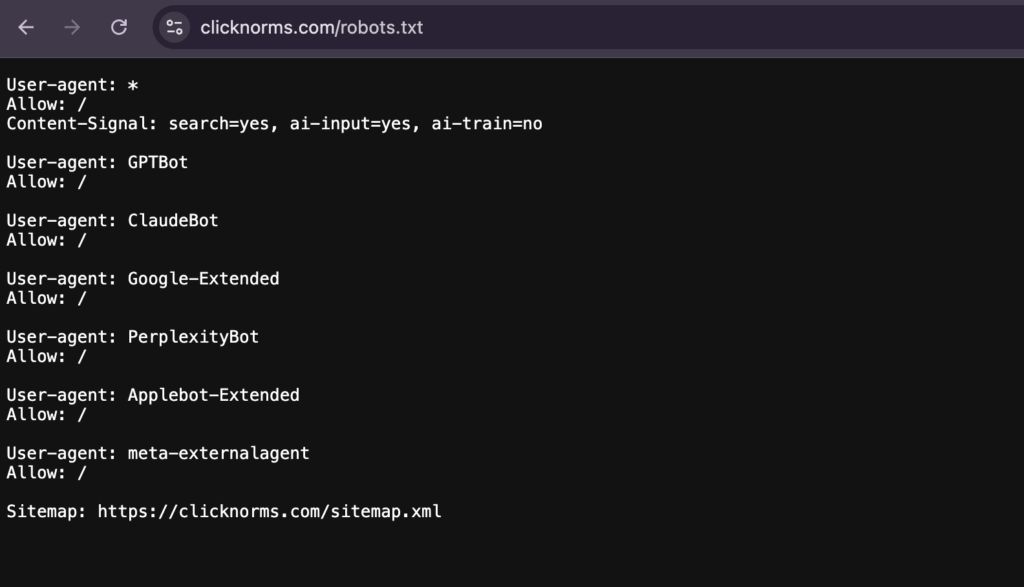
Check your robots.txt file and confirm you are not blocking GPTBot (OpenAI), ClaudeBot (Anthropic), PerplexityBot, Google-Extended, or OAI-SearchBot. Any of these blocks removes you from that platform’s citation pool entirely. The check takes two minutes: go to yourdomain.com/robots.txt and scan the disallow rules.
Expect a 4–8 week lag after Bing submission before ChatGPT begins citing your content consistently. Perplexity’s recency weighting means new content can surface faster, sometimes within 2–4 weeks.
C — Create Third-Party Citations
AI systems gain confidence in recommending a brand when it appears consistently across multiple independent sources. A brand that only exists on its own website is a brand the AI treats with scepticism.
For Sri Lankan brands the highest-priority third-party sources are:
Industry publications. Contribute articles, get quoted in news coverage, submit to local business directories. Daily FT, Sunday Times Business, Roar Media, and LMD are strong sources for Sri Lankan entity signals.
Review platforms. TripAdvisor and Google Reviews for hospitality. LinkedIn recommendations for professional services. App stores for banking and fintech. AI systems read reviews and use them to understand what a brand is known for and how it is perceived.
LinkedIn. Particularly important for B2B brands and professional services. ChatGPT’s entity understanding of companies is heavily influenced by LinkedIn company pages and employee profiles. An incomplete or generic LinkedIn presence weakens entity signals significantly.
Wikipedia. If your brand has genuine market presence, a Wikipedia entry builds strong entity authority. AI systems treat Wikipedia as a high-confidence entity source. Not every Sri Lankan brand qualifies, but for major banks, hotel groups, and established companies, a well-structured Wikipedia entry is one of the highest-ROI GEO investments available.
K — Keep Testing Prompts
Before you can improve your AI visibility, you need to know where you currently stand. Manual prompt testing is the most accessible starting point for Sri Lankan brands.
Write 20–30 prompts that your target buyers would realistically ask ChatGPT or Perplexity. For a hospitality brand, that might include “best luxury villas in southern Sri Lanka”, “boutique hotels near Galle Fort”, and “recommended places to stay in Mirissa for two weeks”. For a bank, it might include “best savings account in Sri Lanka for young professionals” and “which Sri Lankan bank has the best mobile app”.
Test each prompt in ChatGPT and Perplexity. Record whether your brand appears, how it is described, and which competitors appear instead. This becomes your baseline. Use Joy’s free Keyword to AI Prompt Converter to turn your existing keyword list into AI-ready prompts faster.
Repeat the test every 4–6 weeks as you implement the CLICK Framework. Improvements in entity signals and content structure typically show results in Perplexity within 4–8 weeks. ChatGPT takes slightly longer due to the Bing index cycle.
ChatGPT vs Perplexity: Which Matters More for Sri Lankan Brands?
They serve different purposes in a GEO strategy, and both matter, for different reasons.
ChatGPT matters more strategically for most Sri Lankan brands. It has significantly larger consumer adoption globally. Microsoft Copilot, many AI assistants, and various AI workflows run on similar retrieval ecosystems. Brand recommendations inside ChatGPT influence user decision-making earlier in the journey, often before a user has visited any website.
Perplexity matters more diagnostically. It shows citations openly. When Perplexity recommends a brand, you can see exactly which source it pulled from. This makes it the fastest tool for understanding why a brand is or is not appearing, including which sources need to be strengthened, which third-party mentions are working, and where competitors have citation advantages.
For Sri Lankan industries specifically:
| Industry | Priority |
|---|---|
| Hospitality | ChatGPT and Perplexity equally |
| Banking and finance | ChatGPT first |
| Real estate | ChatGPT first |
| B2B technology | ChatGPT and Perplexity equally |
| Travel and tourism | ChatGPT and Perplexity equally |
If you can only track one platform for most Sri Lankan brands today, track ChatGPT: that is where the greatest long-term impact on brand discovery and recommendation behaviour sits. But use Perplexity as your auditing tool. It is the fastest way to understand what is working and what needs to change.
Key takeaway: ChatGPT is your strategic target. Perplexity is your diagnostic tool. Use both, in that order of priority.
How Long Does It Take to Appear in ChatGPT and Perplexity?
Realistic timelines depend on your starting point and which steps you are addressing.
Entity signal fixes, such as Organisation schema, About Us page rewrites, and directory consistency updates, typically take 1–2 weeks to implement and 4–8 weeks to begin influencing AI responses.
Bing submission is immediate to implement. Expect 4–8 weeks before the index reflects your content and ChatGPT begins citing it consistently.
Content restructuring of key service pages takes 2–4 weeks to implement across a medium-sized site. Perplexity typically responds within 4–6 weeks of restructured, answer-first content being indexed. ChatGPT follows within 6–10 weeks.
Third-party presence building, including new directory listings, Wikipedia entries, and media coverage, takes 2–4 months to accumulate enough signal volume to meaningfully shift AI citation patterns.
The brands I have seen move fastest are those that apply the first two steps of the CLICK Framework simultaneously in the first 30 days, Clarify Entity Signals and Lay Out Extractable Content then invest in third-party citations over months two and three. The brands that move slowest are those that focus only on content without fixing the underlying entity problem: they produce well-structured content that AI systems cannot confidently attribute to a trusted brand.
Key takeaway: Expect 6–10 weeks for first meaningful AI visibility improvements after fixing entity signals and content structure. Consistent citation share across multiple platforms typically builds over 3–4 months of focused effort.
Frequently Asked Questions About Appearing in ChatGPT and Perplexity
Does my website need to rank on Google before I can appear in ChatGPT?
Not necessarily for ChatGPT, but yes for Google AI Overviews. ChatGPT uses Bing’s index, which operates independently from Google’s. A brand that does not rank prominently on Google can still appear in ChatGPT if its content is indexed by Bing and its entity signals are strong. Google AI Overviews, however, draw almost entirely from pages already ranking in the top 20 organic results, so strong SEO remains the prerequisite for Google’s AI visibility specifically.
What is the difference between ChatGPT search and regular ChatGPT?
Regular ChatGPT uses its training data, which has a knowledge cutoff. ChatGPT Search (also called SearchGPT) uses real-time Bing retrieval to find current information and cite sources. For brand visibility purposes, the relevant feature is ChatGPT Search, which surfaces brands through real-time retrieval rather than training data. Most commercial queries, such as “best hotel in Colombo”, “recommended bank for a personal loan”, are handled through the search-enabled version.
Why does a smaller competitor appear in ChatGPT instead of my larger brand?
This is one of the most common findings in Sri Lankan GEO audits. AI systems do not weigh brand size. They weigh entity clarity, content structure, and citation footprint. A smaller brand with a clearly defined category, consistent third-party mentions, and answer-first content will be preferred over a larger brand with vague positioning and narrative-heavy pages. The fix is not marketing spend. It is entity building and content restructuring.
How do I know which prompts my customers are asking ChatGPT?
Start by listing the questions your sales team and customer service team hear most often. These are the queries your buyers are likely asking AI platforms as well. Supplement this with keyword research: your existing Google keywords can be converted into AI prompts using a Keyword to AI Prompt Converter. You can also manually test topic variations in ChatGPT itself and observe the related questions it surfaces in its responses.
Is optimising for ChatGPT and Perplexity the same process?
Mostly yes, with two differences. First, ChatGPT relies on Bing indexing, so Bing Webmaster Tools submission is essential. Perplexity crawls more independently. Second, Perplexity weights recency more heavily, so recently updated content tends to surface faster on Perplexity than on ChatGPT. The entity signals, content structure, and third-party presence work applies equally to both platforms, making it efficient to optimise for both simultaneously.
Want to Know If Your Brand Is Appearing in ChatGPT and Perplexity?
The fastest way to find out is a prompt audit: testing 20–30 prompts relevant to your category across both platforms and recording exactly where your brand stands and where competitors are ahead.
If you want a full GEO audit covering entity signals, content structure, citation footprint, and a prioritised action plan, get in touch. I work with brands globally and can assess within the first conversation whether your brand has an entity problem, a content problem, or a citation problem, and which to fix first.